
A transformation can be technically live and operationally absent.
The platform is deployed. The process maps are approved. Training attendance is reported. The steering committee sees green milestones. Yet teams continue working around the new model, decisions still follow old routes and the expected value remains theoretical.
This is often described as a change-management problem. The label is correct; the operating response is frequently too narrow.
When change management is treated as a communications and training workstream attached to a technology programme, it starts too late and owns too little. Adoption depends on decisions made much earlier: what the transformation is trying to change, whether leaders are aligned, how roles and incentives will move, whether processes are genuinely usable and how the organization will respond when operational reality challenges the design.
Change is not adopted because it was announced. It is adopted when the new way becomes clearer, more credible and more workable than the old one.
The false comfort of a separate change workstream
A dedicated change team can add discipline, but separation becomes dangerous when it implies that the rest of the programme can design the future while someone else persuades people to accept it.
That logic reverses cause and effect. If responsibilities are unclear, the process is impractical, data is unreliable or leaders send conflicting signals, more communication will not resolve the underlying defect. It may simply communicate confusion more efficiently.
Change management therefore belongs inside Transformation Strategy & Operating Models from the beginning. The target operating model must define not only structures and systems, but also the behaviours, capabilities, decision rights and management routines required to make it real.
Culture is infrastructure, not atmosphere
Culture is often discussed as if it were the emotional climate surrounding transformation. It is more operational than that.
Culture determines what happens when the programme is not in the room. It appears in which problems are escalated, which risks remain unspoken, how functions collaborate, whether people can challenge an impractical design and whether managers protect the new process when pressure encourages a return to familiar habits.
This is the strongest idea carried forward from Guruti’s earlier culture article: culture is the foundation beneath process and technology. But a foundation cannot remain abstract. Leaders must translate it into observable choices:
- which decisions move closer to the frontline;
- which cross-functional behaviours are expected;
- which legacy incentives contradict the future model;
- how learning and constructive challenge are protected;
- and what leaders will stop doing themselves.
Culture changes through repeated operating evidence. A town hall can explain the intention. Daily decisions reveal whether the intention is true.
Clarity has four levels
“Communicate clearly” is useful advice but an incomplete design standard. Transformation clarity must exist at four connected levels.
1. Outcome clarity
What business result must change, for whom and by when? A system go-live is an event. Faster decisions, lower operational friction, stronger control or a more consistent customer experience are outcomes. If the programme cannot explain the difference, teams will optimize for deployment rather than value.
2. Operating-model clarity
How will work, authority and accountability change? People need to understand who decides, who executes, what information is authoritative and what happens when the standard process meets an exception.
3. Personal clarity
What will be different in each role? Generic messages cannot answer role-specific questions about workload, autonomy, competence, status or performance expectations. Adoption becomes tangible when individuals can see the practical transition from current work to future work.
4. Evidence clarity
How will leaders know that the change is working? Activity measures (communications sent, courses completed or users provisioned) do not prove adoption. Leaders need operational signals such as correct process use, decision-cycle time, exception volume, data quality, customer outcomes and realized benefits.
People, process and technology are not three separate lanes
The legacy ID 14 used a People–Process–Technology framework. The model remains useful if it is treated as an interdependent system rather than three boxes on a slide.
Technology enables and constrains what is possible. Process translates capability into repeatable work. People interpret, decide, collaborate and act. Culture shapes how those three elements behave under pressure. Governance keeps them aligned as the programme learns.
A technically correct workflow can fail if it adds unnecessary steps to frontline work. A well-designed process can fail if the system does not provide reliable information. Capable people can fail if decision rights remain ambiguous. The unit of change is therefore not the tool or the individual; it is the operating environment.
This is why Enterprise Systems, Integration, Data & AI and human readiness should never be planned as consecutive phases. They must be designed together.
Readiness is specific, not a single score
An organization is not simply “ready” or “resistant.” Readiness varies by stakeholder, location, role, process and phase.
One team may understand the purpose but lack the capacity to absorb another initiative. Another may have the skills but distrust the sponsor. A third may support the change but depend on a local workaround that the central design has not recognized.
Prosci’s change-management research consistently connects structured change management, sponsorship and individual adoption with stronger transformation outcomes. The practical implication is not to copy a generic playbook. It is to make readiness evidence-based and actionable.
A useful readiness view examines at least:
- understanding of the business reason and intended outcome;
- leadership alignment and visible sponsorship;
- capacity, competing change and transformation fatigue;
- role impact and capability gaps;
- local process, data and system constraints;
- trust, incentives and perceived consequences;
- and the support available after go-live.
Guruti’s Human Readiness, Change & Adoption practice treats these signals as inputs to transformation design, sequencing and governance, not as a late sentiment survey.
Resistance is information
Some resistance is political, and some is simply preference for the familiar. But resistance can also identify design defects, hidden dependencies, unsafe workload assumptions and operational exceptions that the programme has missed.
Leaders should neither romanticize resistance nor suppress it automatically. They should diagnose it.
- Listen for the underlying risk. What outcome does the person believe is threatened?
- Separate misunderstanding from design evidence. Does the issue require explanation, capability or redesign?
- Make the decision explicit. Accept, adapt or reject the feedback, and explain why.
- Close the loop. Silence after consultation teaches people that participation is theatre.
This turns stakeholder engagement from a communications channel into a source of operational intelligence.
Govern adoption as seriously as delivery
Programme governance usually monitors scope, cost, schedule, risks, actions, issues and dependencies. Adoption should receive the same executive discipline.
A strategic Transformation PMO should be able to answer:
- which roles and locations face the greatest transition impact;
- where sponsorship is active, inconsistent or absent;
- which operational behaviours define adoption;
- where capability, capacity or incentive gaps threaten value;
- which workarounds are emerging and why;
- and whether benefits are appearing in operations after deployment.
This does not require another reporting bureaucracy. It requires integrating a small number of meaningful human and operational indicators into decisions already being made.
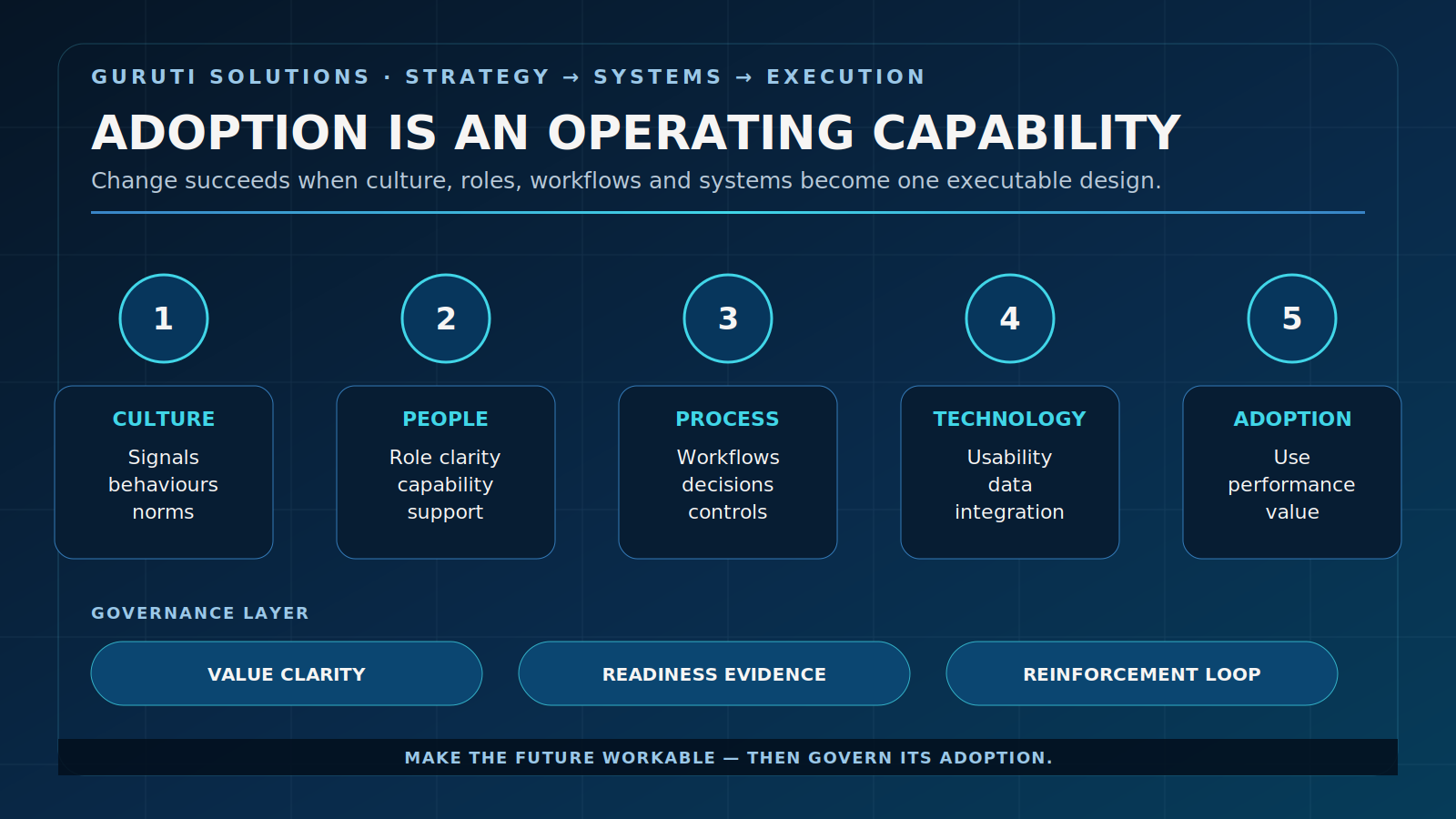
A practical adoption architecture
Leaders can build adoption into the programme through seven design moves:
- Define value before activity. State the business and operational outcomes the change must create.
- Map the transition by role. Show how work, decisions, skills and measures will change for affected groups.
- Design with operational reality. Include frontline expertise early enough to influence, not merely validate, the solution.
- Align leaders on decisions and behaviour. Sponsorship must be visible in trade-offs, resources and reinforcement.
- Build capability near the moment of use. Combine learning, practice, manager support and accessible guidance.
- Measure adoption through operations. Track the behaviours and outcomes that indicate the future model is taking hold.
- Reinforce and adapt. Remove contradictory incentives, address friction and improve the design as evidence emerges.
Communication and training remain important. They become far more effective when they operate inside this architecture.
Executive diagnostic
- Can every major stakeholder explain the business outcome, not only the project?
- Have leaders agreed how their own decisions and behaviours must change?
- Do we understand role-level impacts before finalizing process and system design?
- Where is the organization already saturated by competing change?
- Which operational concerns are being mislabelled as resistance?
- Are managers equipped to translate the transformation for their teams?
- What observable behaviours will prove adoption?
- Which incentives, metrics or policies still reward the old way of working?
- Does the PMO govern human readiness alongside delivery risk?
- How will support, learning and reinforcement continue after go-live?
Make the future workable
Transformation requires clarity and alignment, but neither is achieved through messaging alone. Clarity must connect strategy to roles and decisions. Alignment must survive operational pressure. Culture must become visible in management routines. Systems and processes must make the desired behaviour possible.
The real test of change management is not whether people heard the transformation story. It is whether the organization can operate the story.
That is the shift from a change workstream to an adoption capability, and from implementation activity to measurable transformation.
If your programme is technically progressing but operational adoption remains uncertain, Guruti can help connect strategy, systems and human readiness. Book a Strategy Session