
AI implementation governance is becoming one of the defining management challenges of enterprise AI. The technology may work. The pilot may impress. But neither guarantees that AI will become an operational capability that people use, processes support and leaders can govern.
Enterprise AI has moved quickly from experimentation into the executive agenda.
Organizations are testing copilots, automation, generative AI, intelligent workflows and increasingly autonomous capabilities across functions. Access to technology is expanding. Vendors are embedding AI into existing enterprise platforms. Individual teams can experiment faster than ever.
Yet the harder question increasingly comes after the pilot:
How do we turn a promising AI use case into something that actually works inside the business?
Deloitte's 2026 State of AI in the Enterprise highlights this gap. Only 25% of surveyed organizations had moved at least 40% of their AI pilots into production. Its analysis also points to a broader challenge: AI creates more value when it is embedded into business workflows rather than introduced as an isolated tool.
That distinction matters.
A technically successful pilot is not yet an implementation.
An implementation is not yet adoption.
And adoption is not automatically business value.
The organizations that move successfully from experimentation to operational impact will need more than good technology. They need clear ownership, implementation governance, process and system integration, prepared people, effective onboarding, measurable adoption and disciplined value realization.
That is the AI implementation gap.
And closing it is primarily a transformation challenge.
A successful AI pilot is not yet a business capability
A pilot is designed to answer an important question:
Can this work?
Operational implementation must answer several more:
- Should we scale it?
- Who owns the outcome?
- Where does it fit into the operating model?
- Which processes must change?
- Which systems must connect?
- What decisions remain human?
- Who needs to work differently?
- How will people learn to use it?
- How will adoption be measured?
- Who intervenes when something goes wrong?
- How will we know whether it is creating value?
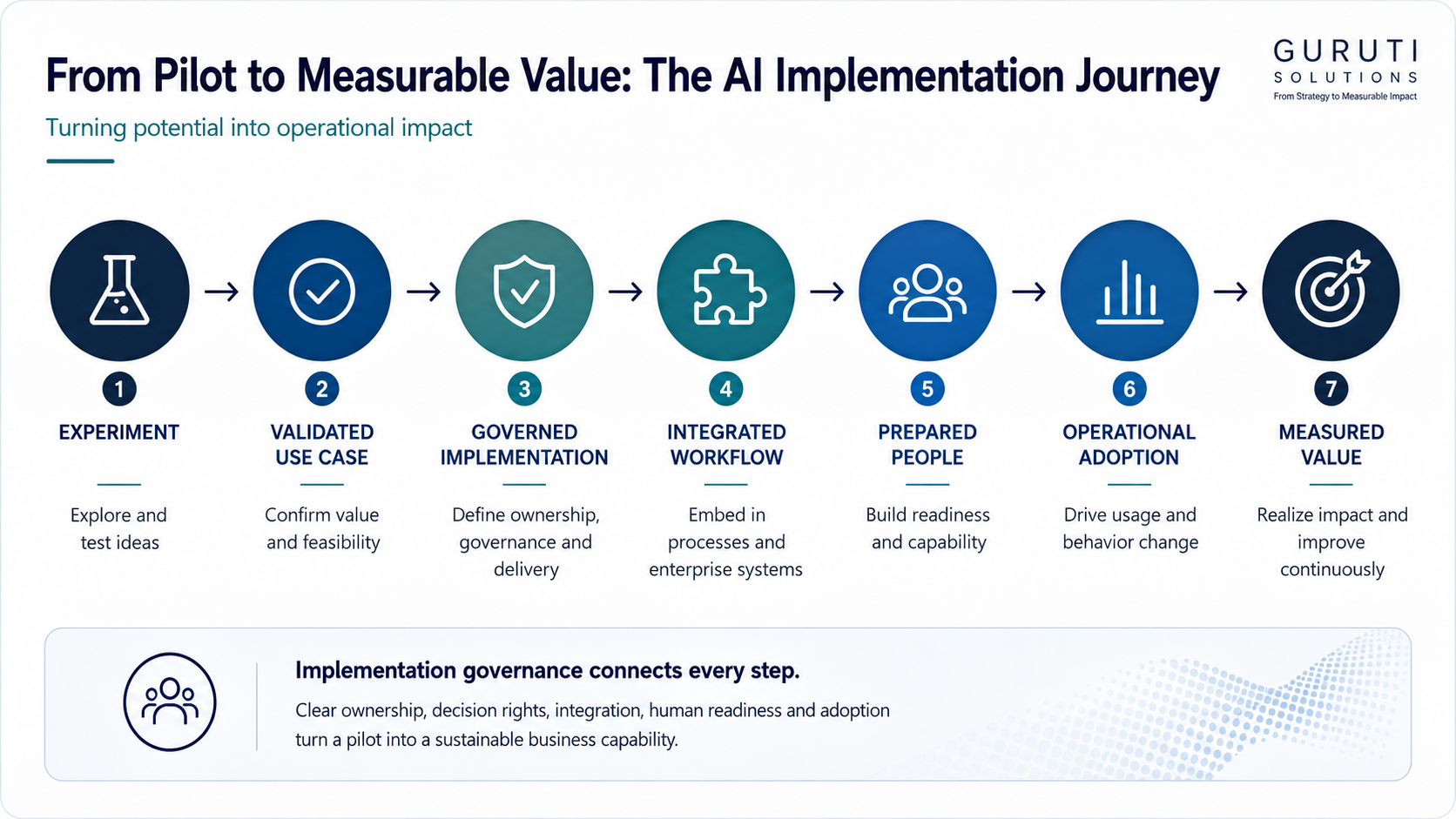
The journey therefore looks less like:
Idea → Pilot → Rollout
and more like:
Experiment → Validated Use Case → Governed Implementation → Integrated Workflow → Prepared People → Operational Adoption → Measured Value
Each transition introduces decisions that technology alone cannot resolve.
An AI capability may perform exactly as intended and still produce limited business value if it sits outside the real workflow, lacks executive ownership, creates additional work, depends on unreliable inputs, confuses users or never becomes part of how the organization operates.
This is why enterprise AI increasingly needs to be treated as an implementation and operating-model challenge, not simply a technology deployment.
AI implementation requires an operating model, not just a tool
Implementation governance does not mean creating another committee or adding bureaucracy around every AI initiative.
Done well, governance does the opposite.
It makes the important decisions explicit before ambiguity becomes delay, rework, risk or organizational resistance.
A practical implementation model connects:
Business Outcome
↓
Ownership
↓
Governance
↓
Implementation
↓
Process & Systems Integration
↓
Human Readiness
↓
Adoption
↓
Monitoring & Value
The technology sits inside this system. It is not the system itself.
This distinction becomes especially important as organizations combine internal teams, enterprise software vendors, specialist developers, integration partners, data capabilities and external AI solutions.
No single participant necessarily needs to do everything.
But somebody needs to ensure that all those capabilities are working toward the same business outcome.
That is the role of implementation governance.
15 executive questions before scaling AI
The following questions are not intended as a technical AI audit.
They are an executive readiness assessment for organizations moving from AI experimentation toward operational implementation and adoption.
The more consequential the initiative, the more important it becomes to answer them before scale introduces additional complexity.
1. What business outcome is this AI initiative expected to improve?
The starting point should not be:
“Where can we use AI?”
It should be:
“Which business outcome or operational problem are we trying to improve?”
That distinction sounds simple but changes the entire implementation.
A use case may target productivity, decision quality, customer experience, response time, service consistency, revenue opportunities, operational capacity or another measurable outcome.
The appropriate measure will differ by initiative.
What matters is that the organization can connect the technology to an identifiable business need.
Without that anchor, teams risk optimizing the tool rather than improving the operation.
What good looks like: a clearly defined business problem, an intended outcome and an accountable business owner.
2. Who owns the business outcome?
AI initiatives often have many stakeholders but surprisingly little ownership.
There may be an executive sponsor, an IT owner, a software vendor, a project manager, a business lead and an implementation partner.
Those roles are useful.
They are not interchangeable.
One person or clearly defined business function should ultimately be accountable for whether the initiative produces the intended operational outcome.
This becomes increasingly important as AI moves into real workflows and decisions.
The NIST AI Risk Management Framework similarly emphasizes clearly defined organizational roles and responsibilities, with executive leadership taking responsibility for decisions associated with AI deployment and risk.
What good looks like: technology ownership and project management support a clearly accountable business owner rather than replacing one.
3. Why this use case, and why now?
Not every technically feasible AI use case deserves implementation.
Organizations need a disciplined way to distinguish between an interesting possibility and a meaningful transformation priority.
A useful executive lens combines four dimensions:
Business value × Feasibility × Organizational readiness × Risk
A high-profile use case with weak operational readiness may be less valuable than a modest initiative that solves a real business problem and can be integrated quickly.
Likewise, an apparently attractive automation may have little strategic relevance once implementation cost, process dependencies and adoption requirements are understood.
Governance starts with the ability to say both yes and not yet.
What good looks like: a prioritized use case portfolio based on business relevance rather than technological novelty.
4. What does success actually mean?
A successful demonstration and a successful implementation are different things.
Before scaling, leadership should define the measures that determine whether the initiative is working.
Depending on the use case, these could include:
- quality or consistency;
- cycle time;
- employee productivity;
- customer response;
- operational capacity;
- error reduction;
- adoption;
- cost;
- revenue contribution;
- service improvement;
- risk reduction.
Not every initiative needs every metric.
But every initiative needs a definition of success.
This is particularly important for AI because apparent usage can easily be mistaken for value.
What good looks like: a small set of agreed indicators covering operational performance, adoption and intended business impact.
5. Who has authority to make implementation decisions?
AI projects can stall when decision rights remain ambiguous.
Who can approve a change in scope?
Who decides whether the initiative is ready to progress?
Who accepts a process trade-off?
Who resolves disagreement between technology and business teams?
Who approves an exception?
Who makes the go/no-go decision?
Who decides whether a problem requires escalation?
These questions become more significant as the number of stakeholders grows.
A Transformation PMO or equivalent governance structure can help create the decision rhythm, dependencies, stage gates and escalation paths required to keep implementation moving.
The objective is not administrative control.
It is decision clarity.
What good looks like: decisions are taken at the right level, by the right owner, within an understood governance structure.
6. Which business process has to change?
An AI solution does not create transformation simply because users can access it.
The more useful question is:
What work will be performed differently once this capability exists?
A process may need to change because AI:
- accelerates an existing activity;
- provides additional information;
- removes repetitive work;
- changes sequencing;
- introduces a recommendation;
- automates part of a workflow;
- creates a new exception path;
- changes responsibilities between roles.
If the future process cannot be described, the implementation may still be a technology experiment.
This is one of the most important distinctions between installing a capability and operationalizing one.
What good looks like: the future workflow, responsibilities, handoffs and exceptions are understood before organization-wide rollout.
7. Which systems and workflows must it work with?
Enterprise work rarely happens inside a single application.
An AI capability may eventually interact with ERP, CRM, finance, HR, customer service, hospitality, collaboration, data or other operational platforms.
The executive question is not how the technical integration will be engineered.
That belongs to the appropriate specialists.
The management question is:
Which operational information and systems must work together for the use case to function as intended?
This determines dependencies, ownership, sequencing and often the real complexity of implementation.
A solution that performs brilliantly in isolation may add little value if employees must manually move information between disconnected systems to use it.
What good looks like: the required system landscape and workflow dependencies are identified early and incorporated into the implementation plan.
8. Is the required data operationally ready?
AI discussions can quickly become technically complex when data enters the conversation.
Executive teams do not need to become data engineers.
They do need to understand the operational questions.
What information does the capability need?
Where does it come from?
Who owns it?
Is it sufficiently reliable for the intended use?
Who can access it?
What information should the solution not use?
How will changes in source information affect the process?
Data readiness is therefore not only a technical dependency. It is also an ownership and operating-model issue.
What good looks like: business and technical teams share a clear understanding of required information, ownership, access and critical dependencies.
9. What should we buy, configure, integrate or build?
One of the most consequential AI decisions may happen before implementation begins.
Organizations increasingly have four broad options:
Buy. Configure. Integrate. Build.
The correct choice depends on the business need.
A capability already embedded in an enterprise platform may require configuration and adoption rather than custom development.
Another use case may require integration across several systems.
A strategically distinctive workflow may justify specialized automation or development.
More complex requirements may require dedicated AI or software engineering specialists.
The objective should not be to maximize custom development or minimize it.
It should be to select the delivery model that best fits the business outcome, existing architecture, required differentiation and implementation reality.
What good looks like: internal teams, vendors and specialist partners have clearly defined responsibilities around one implementation objective.
10. Where must human judgment remain?
The relevant question is rarely whether the organization should choose between humans or AI.
It is usually where each should contribute.
AI may generate, recommend, classify, prioritize, predict, summarize or automate.
But some decisions may still require human validation, contextual judgment, authorization or accountability.
Those boundaries should be deliberate.
NIST's AI RMF specifically calls for organizations to define roles and responsibilities for human–AI configurations and oversight rather than leaving them implicit.
This is both a governance and process-design question.
What good looks like: users understand what AI can support, what they remain responsible for and when intervention or escalation is required.
11. Who will have to work differently?
Every meaningful technology implementation eventually becomes a people question.
Who will experience a change in their role?
Which managers will supervise a different workflow?
Which employees will need to interpret AI-supported outputs?
Which teams may lose an existing task but gain a new responsibility?
Who will need to collaborate differently?
Which external partners or customers may experience the change?
This is where technical readiness and organizational readiness can diverge.
The capability may be ready for production while the organization is not yet ready to absorb it.
That gap should be identified before launch rather than discovered through poor adoption afterwards.
What good looks like: impacted groups, role changes and readiness requirements are mapped as part of implementation, not added after the technical work is complete.
12. How will users be onboarded and enabled?
Sending employees a link to an AI tool is not an adoption strategy.
Neither is a single generic training session.
Effective onboarding should help users understand:
- Why the capability is being introduced.
- Where it fits into their work.
- When it should be used.
- How to use it appropriately.
- What remains their responsibility.
- Where to get support.
- And how to escalate uncertainty.
A useful enablement sequence can move through:
Awareness → Role Understanding → Use-Case Learning → Practice → Support
This has also gained regulatory relevance in Europe. The EU AI Act requires providers and deployers to take measures supporting AI literacy among people dealing with AI systems on their behalf, taking account of their knowledge, experience and the context of use. That does not prescribe a single training model, but it reinforces the importance of deliberate organizational enablement.
What good looks like: onboarding is role-based, contextual and connected to the actual workflow rather than limited to generic AI awareness.
13. How will we know whether people are actually adopting it?
Activation is not adoption.
Training attendance is not adoption.
Licenses assigned are not adoption.
Even repeated tool usage may not prove that the intended business process has changed.
A stronger measurement chain is:
Usage → Behavior Change → Process Change → Outcome
For example, an organization may discover that employees frequently access an AI capability but continue using the old workflow for the decisions that matter.
That is usage without transformation.
Adoption therefore needs operational measures alongside technical usage data.
What good looks like: leadership can see whether the capability is being used as intended, whether behavior is changing and whether the underlying process is improving.
14. What happens when something goes wrong?
Operational systems need exception paths.
AI is no different.
What happens when a result appears incorrect?
When a user does not trust a recommendation?
When integration fails?
When the underlying process changes?
When a vendor changes functionality?
When employees identify an unexpected behavior?
When responsibility between teams is unclear?
Governance should define a simple operational cycle:
Detect → Escalate → Decide → Correct → Learn
Monitoring is not solely a technical activity. Organizations also need operational feedback, ownership and decision mechanisms.
The NIST AI RMF similarly treats governance, monitoring, accountability and escalation as continuing lifecycle activities rather than one-time implementation tasks.
What good looks like: employees know where to raise issues, accountable teams know who decides, and lessons feed back into the implementation.
15. How will we decide whether to scale, change or stop?
Not every successful pilot deserves scale.
And not every implementation should continue indefinitely.
An executive review should allow several legitimate outcomes:
Scale: The capability is producing value and the organization is ready for broader deployment.
Adapt: The concept is valid but the process, technology, scope or implementation model needs adjustment.
Contain: The capability has value in a limited context but should not expand further.
Replace: A better solution or delivery model has emerged.
Stop: The expected value, readiness or business case no longer justifies continued investment.
Stopping a weak initiative is not necessarily failure.
Continuing it because the organization has already invested in it often is.
What good looks like: scale decisions are based on evidence rather than enthusiasm or sunk cost.
AI Implementation & Adoption Readiness Assessment
15 Executive Questions Before You Scale
Is your AI initiative ready to move beyond the pilot?
Use this practical executive assessment to identify potential gaps in business ownership, governance, process and systems integration, human readiness, onboarding, adoption and value realization before committing to broader scale.
15 questions · 5 readiness dimensions · Executive scoring
The hidden implementation gap: technology can be ready before the organization is
Technology and organizations rarely evolve at the same speed.
A team may successfully configure or develop an AI capability in weeks while the surrounding organization still needs to resolve:
- executive alignment;
- process ownership;
- new responsibilities;
- manager expectations;
- employee concerns;
- capability gaps;
- operating procedures;
- support mechanisms;
- measures of success.
This is why human readiness should not be treated as a communications workstream at the end of the project.
It is an implementation dependency.
Leadership may be ready while managers are uncertain.
Managers may understand the initiative while frontline users do not see its relevance.
Employees may understand the tool but distrust how it affects their work.
Different groups can therefore be in different states of readiness at the same moment.
Understanding those differences helps organizations design more appropriate onboarding, communication, support and adoption interventions.
For Guruti, this connects directly with our work in Human Readiness, Change & Adoption and the public principles behind Transition Mindset Mapping™: transformation becomes more sustainable when leaders understand how people are experiencing the transition rather than assuming that one implementation message will work for everyone.
Governance should accelerate implementation, not become another approval layer
Poor governance creates bureaucracy.
Good governance reduces ambiguity.
The distinction matters.
An implementation governance model should make five things clear:
Ownership: who is accountable.
Decision rights: who decides what.
Stage gates: what must be true before progressing.
Escalation: how unresolved issues move.
Measures: how progress and value are evaluated.
Once these are explicit, delivery teams can often move faster because they spend less time negotiating authority, waiting for decisions or discovering dependencies late.
This is particularly important in AI initiatives involving several internal functions and external specialists.
The objective is not to centralize every decision.
It is to make accountability visible enough that decentralized teams can execute confidently.
The right delivery model may involve multiple specialists
AI implementation can create pressure to find one provider capable of solving every part of the problem.
That is not always the best model.
A complex initiative may combine:
- Business leadership
- Transformation governance / PMO
- Internal process owners
- Enterprise systems teams
- Data specialists
- Technology vendors
- AI and automation developers
- Security, legal or risk specialists where required
- Change and adoption capability
The relevant question is not whether one organization performs every role.
It is whether those roles operate as one implementation system.
Specialist AI developers may be the right partners for complex automation or custom technical development.
Enterprise software providers may own product capabilities.
Internal teams may own data, infrastructure or operations.
Guruti's role is different.
Our focus is on connecting the business transformation around the technology: clarifying outcomes, establishing governance, coordinating implementation, aligning processes and systems, preparing people, supporting adoption and maintaining focus on operational impact.
The objective is not for one provider to do everything. It is for the different capabilities to work together toward one business outcome.
From AI initiative to operational capability
Enterprise AI is moving into a more demanding phase.
Experimentation remains important, but access to technology is no longer the only constraint.
The challenge increasingly becomes the transition:
The organizations that manage these transitions well will not simply deploy more AI.
They will become better at turning new technology into operational capability.
That requires the same disciplines that successful transformation has always required:
- clear strategy;
- accountable leadership;
- effective governance;
- integrated processes and systems;
- prepared people;
- disciplined execution;
- and measurable outcomes.
AI changes the possibilities.
It does not remove the need to transform the organization around them.
AI Implementation & Adoption Readiness Assessment
15 Executive Questions Before You Scale
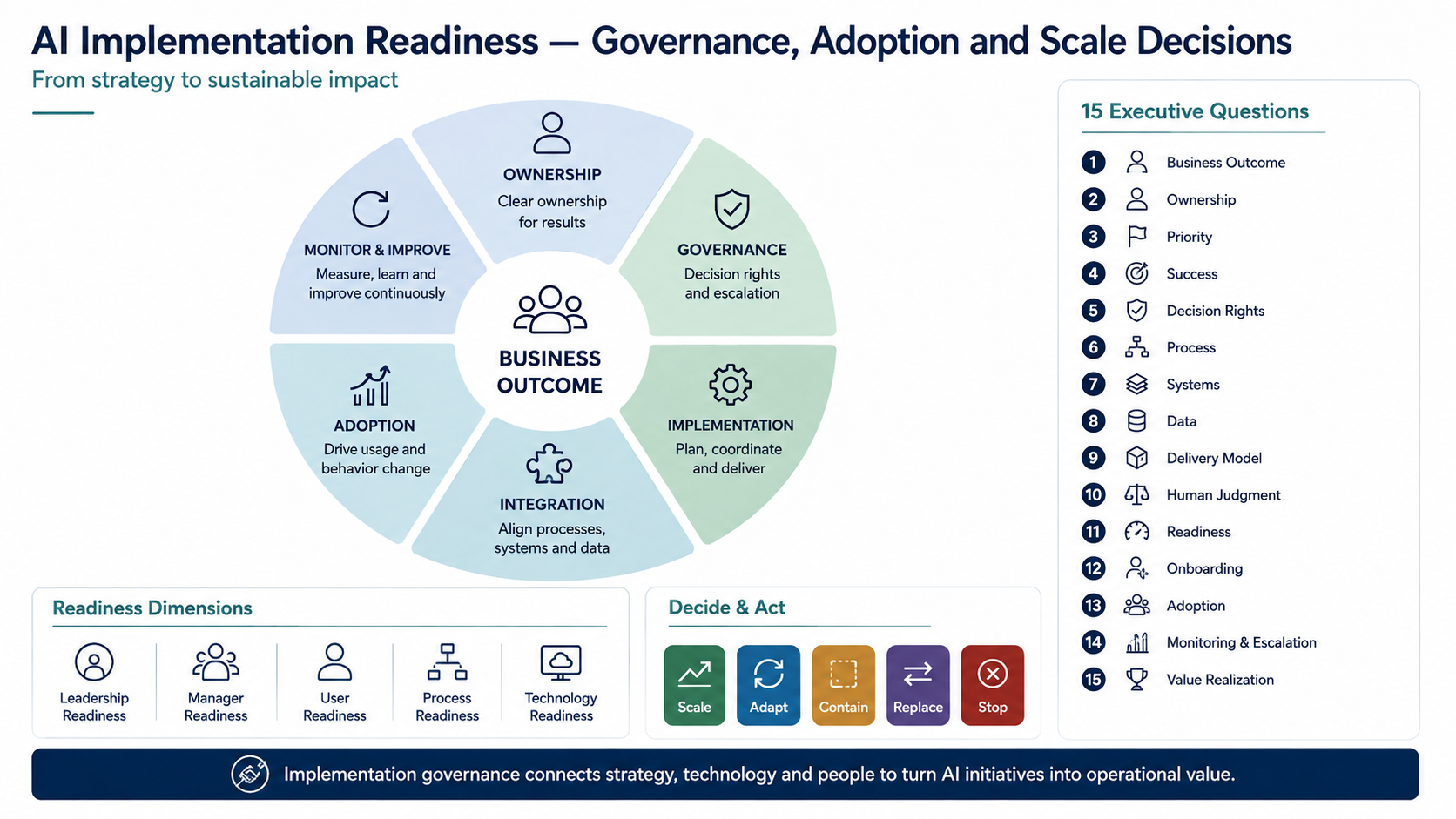
Before moving an AI initiative beyond pilot stage, leadership should be able to answer:
- Business outcome: What business result are we trying to improve?
- Ownership: Who is accountable for achieving that result?
- Priority: Why this use case, and why now?
- Success: What evidence will tell us that it is working?
- Decision rights: Who can approve, change, escalate or stop the initiative?
- Process: What work will actually be performed differently?
- Systems: Which workflows and enterprise systems must it work with?
- Data: Is the required information sufficiently ready and owned?
- Delivery model: What should we buy, configure, integrate or build?
- Human judgment: Where must human responsibility and oversight remain?
- Readiness: Who will have to work differently?
- Onboarding: How will users understand, practice and receive support?
- Adoption: How will we know behavior and processes are actually changing?
- Monitoring & escalation: What happens when something does not work as intended?
- Value realization: What evidence will determine whether we scale, adapt or stop?
If several of these questions do not yet have clear answers, the next priority may not be another AI feature.
It may be implementation readiness.
Moving an AI initiative from pilot to operational reality?
Guruti Solutions helps organizations turn strategic transformation into operating reality by connecting leadership, governance, processes, systems, implementation and human adoption.
For AI-enabled transformation, our role is not to replace specialist AI developers or technology providers.
We help create the implementation environment around them: clarifying business outcomes, establishing governance, coordinating complex delivery, aligning technology with real workflows, preparing people for change and maintaining focus on adoption and measurable impact.
Strategy → Systems → Execution
Align | Transform | Grow
From Strategy to Measurable Impact
Discuss your transformation → Book a Strategy Session
Frequently Asked Questions
AI implementation governance is the structure used to define ownership, decision rights, implementation responsibilities, process and system dependencies, escalation mechanisms and success measures for an AI initiative.
Its purpose is not simply to control technology. Effective governance helps move an initiative from a validated use case into an operational capability while maintaining accountability and alignment with the intended business outcome.
There is rarely one reason.
Common implementation barriers can include unclear ownership, weak business cases, unresolved integration dependencies, insufficient data readiness, unclear decision rights, process misalignment, lack of user readiness and difficulty demonstrating value.
A technically successful pilot therefore does not automatically mean that an organization is ready to scale it.
Technical teams or vendors may own important components, but the intended business outcome should have a clear business owner.
Larger implementations may also require executive sponsorship, transformation governance or PMO, process owners, technology specialists and change/adoption capability.
The critical principle is that responsibilities and decision rights are explicit.
Tool access or licence activation alone is insufficient.
A useful approach is to examine the progression:
Usage → Behaviour Change → Process Change → Business Outcome
This helps distinguish between employees simply accessing an AI capability and the organization actually changing how work is performed.
Before scaling, leaders should assess the business outcome, ownership, implementation governance, process impact, systems and data dependencies, delivery model, human oversight, organizational readiness, onboarding requirements, adoption measures, monitoring, escalation and expected value.
The core question is not simply whether the technology works.
It is whether the organization is ready to make it operational.