
Hospitality does not allow transformation to remain theoretical for long.
A hotel operates continuously across reservations, distribution, pricing, arrivals, housekeeping, maintenance, payments, food and beverage, events, finance and guest service. Multiple teams and systems contribute to one experience. When a handoff fails, the consequence becomes visible, often immediately and directly to the customer.
That makes hospitality a demanding environment, but also an unusually useful transformation laboratory.
The lesson is not that manufacturing, professional services, healthcare, construction or retail should copy hotel processes. Their economics, risks and regulatory realities differ. What can travel are the operating disciplines developed when strategy, systems, people and execution must remain connected under live conditions.
Hospitality teaches transformation in public: every disconnected process eventually appears in the experience.
Why hospitality exposes transformation reality
Many enterprises can hide fragmentation for a time. Teams reconcile data in spreadsheets, experienced employees bridge broken handoffs and customers see only part of the complexity.
Hotels have fewer places to hide. Inventory is perishable. Demand and price change. Operations are distributed across properties and shifts. A guest journey crosses commercial and operational functions. Service cannot simply stop while a new system is stabilized.
Modern hospitality platforms reflect that interconnected reality. Oracle’s Hospitality Integration Platform, for example, exposes domains spanning reservations, profiles, housekeeping, inventory, rates, back-office activity and events. The technology is industry-specific; the underlying lesson is universal: business outcomes cross application and organizational boundaries.
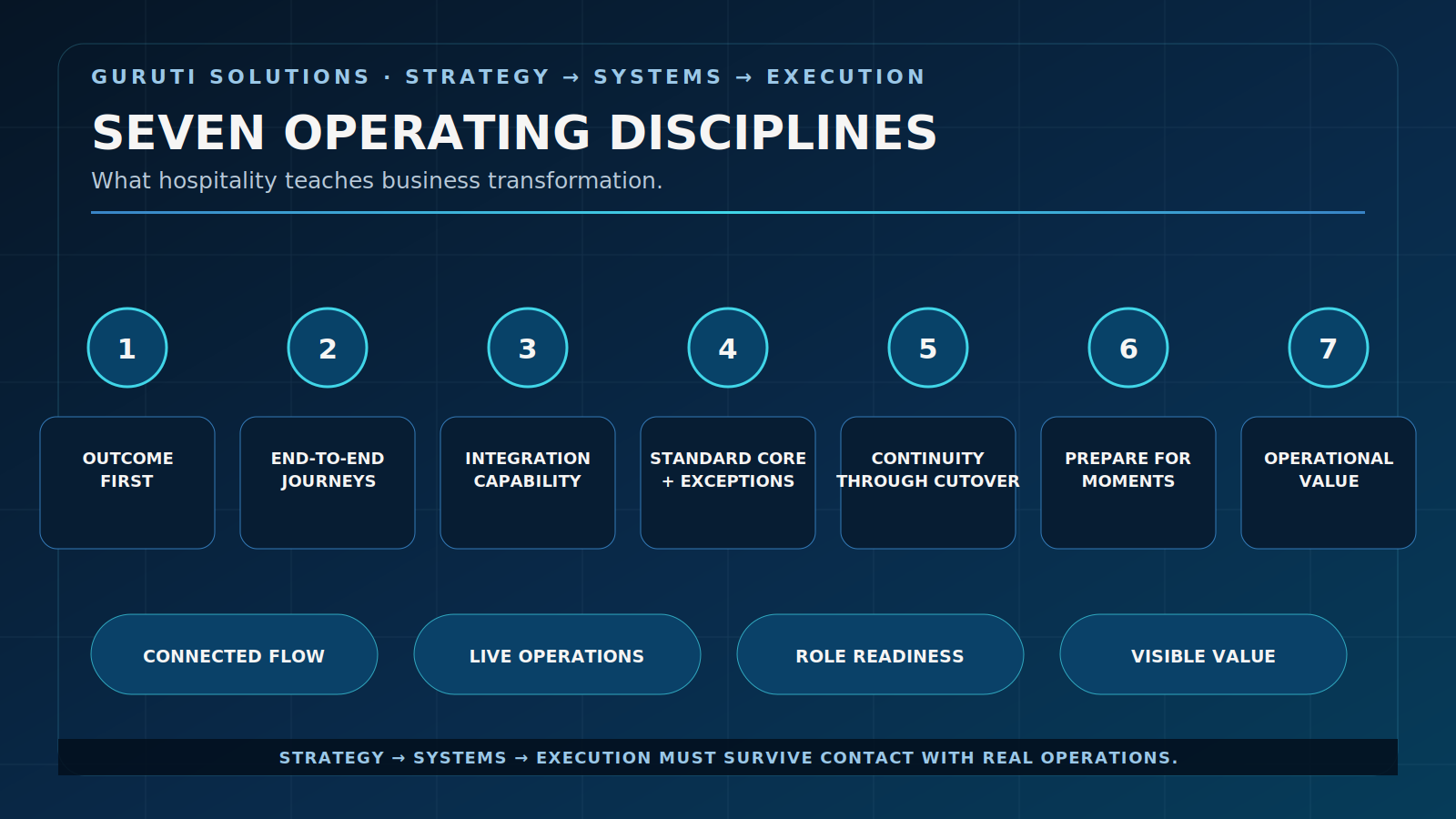
Discipline 1: Design from the operating outcome
Transformation programmes often begin with a selected platform and then work backwards to justify it. Hospitality punishes this sequence because a technically successful deployment can still disrupt arrivals, room readiness, rate distribution or financial reconciliation.
The better starting point is the operating outcome: what must become faster, safer, clearer, more consistent or more valuable? Technology choices then support a designed way of working.
This principle sits at the heart of Transformation Strategy & Operating Models: define capabilities, decisions, processes and accountabilities before treating the solution as a configuration exercise.
Discipline 2: Manage the journey across functions
A guest does not experience the organization chart. The reservation, pre-arrival message, front desk, room status, payment and service recovery form one journey even when different departments own each step.
The same is true of a B2B order, a patient pathway, an employee onboarding process or a construction change request. Customers and users experience the handoffs that internal structures tend to fragment.
Journey ownership therefore needs:
- a defined end-to-end outcome;
- clear handoffs and decision rights;
- shared measures across functions;
- visible exception paths;
- and authority to resolve cross-functional friction.
Discipline 3: Treat integration as an operating capability
In hospitality, PMS, CRS, booking engines, channels, payments, CRM, POS, revenue systems and operational tools can all participate in one transaction or decision. Integration is not simply a technical connection; it determines whether information arrives with the right meaning, timing and ownership.
That distinction applies in every connected enterprise. An API may transport data while the business remains disconnected because identifiers conflict, exceptions are unmanaged or no function owns the resulting action.
Enterprise Systems, Integration, Data & AI must therefore connect architecture to decisions, controls and operational accountability.
Discipline 4: Standardize the core and design the exception
Distributed operations need standards. Without them, every site, team or manager creates a local version of the process, making control and scaling progressively harder.
But standardization cannot mean pretending that exceptions do not exist. Hospitality teams constantly manage early arrivals, unavailable rooms, group changes, payment issues, special requirements and service recovery. Strong operations define both the normal path and the authority to handle deviation.
The transferable rule is simple: standardize what must be consistent; make legitimate variation explicit; and govern exceptions as data for improvement.
Discipline 5: Protect continuity during the transition
A hotel cannot suspend service for transformation. Migration, training, cutover, hypercare and stabilization must coexist with the daily operation.
Other sectors face the same principle even when the tempo differs. Continuity planning should cover operational fallbacks, decision escalation, staffing capacity, data reconciliation, supplier dependencies and customer communication, not only technical rollback.
A value-oriented Transformation PMO makes these dependencies visible and governs readiness across business, technology and operations.
Discipline 6: Prepare people for moments, not modules
Traditional training follows the system menu. Operational readiness follows the moment of work.
A reservations agent, finance analyst, maintenance lead and general manager may use the same platform for entirely different decisions. Each needs role-specific practice, scenarios, exception handling and support near the point of use.
That is why Human Readiness, Change & Adoption should be integrated into design and testing. Adoption is more likely when the future process is workable, managers can reinforce it and people understand how to act when reality departs from the script.
Discipline 7: Measure value where operations can see it
Programme milestones are necessary but incomplete. A completed interface, migrated dataset or delivered course is evidence of activity. Value appears when the operation changes.
Useful measures might include reduced reconciliation, faster decisions, fewer manual handoffs, stronger data quality, more consistent service, lower exception volume or better control. The correct measures depend on the strategic outcome.
The ISO quality-management principles emphasize process thinking, customer focus, evidence-based decisions and continual improvement. Those disciplines are as relevant to transformation governance as to steady-state operations.
What should not be copied blindly
Cross-industry learning becomes weak when analogy replaces analysis.
- Perishable hotel inventory does not behave like every product or service.
- Guest-experience measures cannot simply replace regulated, clinical, safety or engineering outcomes.
- Property-level autonomy may be appropriate in one model and dangerous in another.
- Dynamic pricing, loyalty and partner ecosystems require different controls across sectors.
The transferable asset is not a hotel playbook. It is the ability to see the enterprise as a connected operating system and adapt the discipline to context.
A cross-industry transformation test
- Can we name the operating outcome independently of the technology?
- Who owns the journey across functional boundaries?
- Where do employees manually compensate for broken integration?
- Which data is authoritative at each decision point?
- What is globally standard, locally variable and genuinely exceptional?
- Can operations continue safely during cutover and stabilization?
- Are people prepared for real scenarios or only trained on features?
- Which operational measures will prove that value has arrived?
- How does feedback change the process after go-live?
From sector experience to transformation capability
Hospitality is one of Guruti’s areas of deep operating experience, but the value of that experience is broader than the sector. It develops a practical instinct for connected journeys, distributed execution, live-system transitions and the human consequences of fragmented design.
Guruti’s Hospitality Technology Transformation work informs a wider cross-industry proposition: strategy must be translated into an operating model; systems must support the complete flow of value; and execution must survive contact with reality.
The transferable advantage is not knowing one sector’s systems. It is knowing how to transform while the real business keeps moving.
If your transformation crosses systems, functions and operating boundaries, Guruti can help convert complexity into a practical path from strategy to measurable execution. Book a Strategy Session