
Selecting a property management system can feel like the decisive moment in a hotel technology transformation.
It is not.
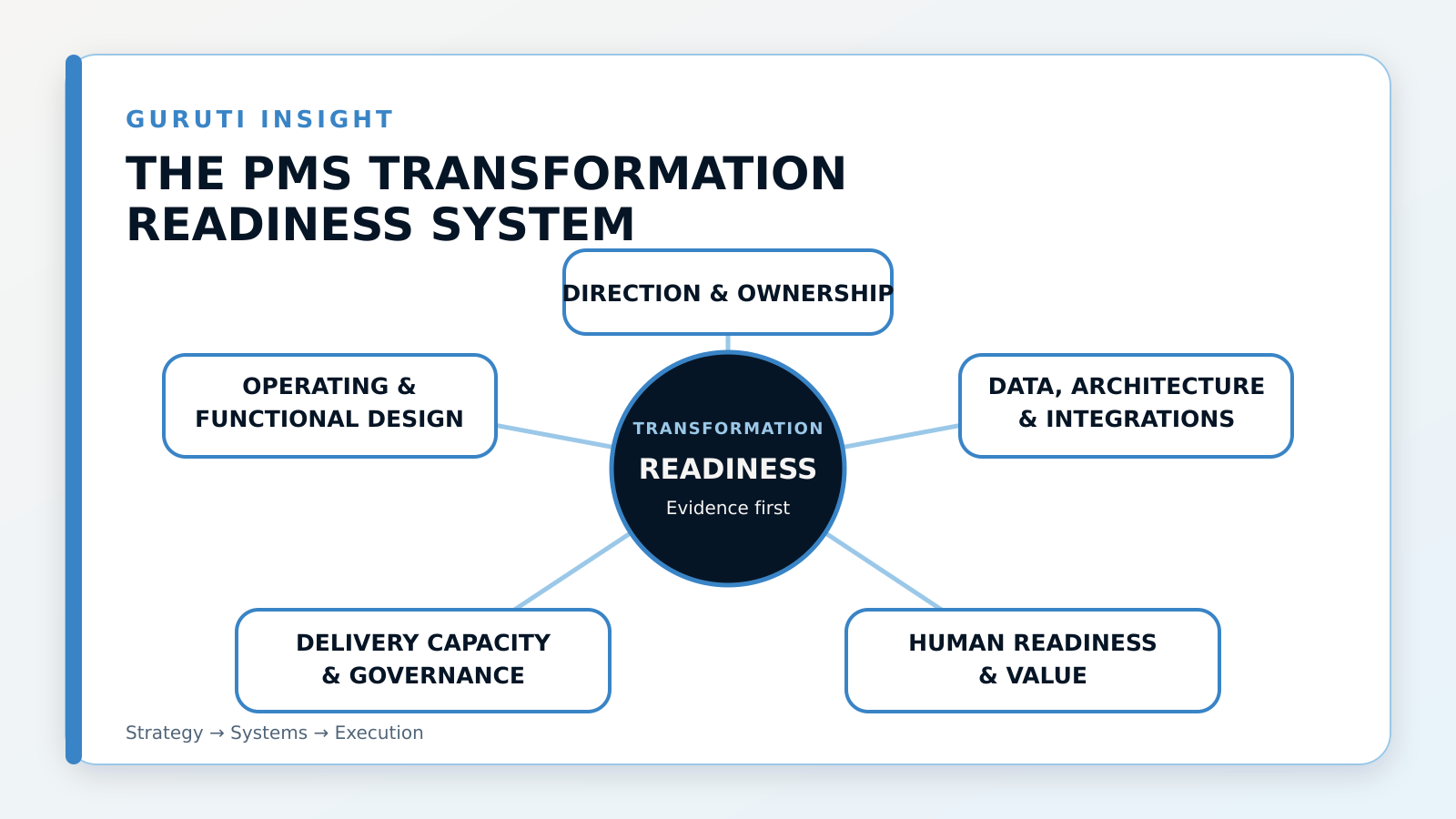
The more consequential decision is whether the organization is ready to redesign how hotels, central teams, partners and connected platforms will operate together once the new PMS is live.
A modern PMS touches far more than reception. It can change reservation ownership, inventory and rate flows, payment handling, cashiering, financial controls, reporting, guest profiles, integrations, role boundaries and the decisions that move between properties and corporate functions.
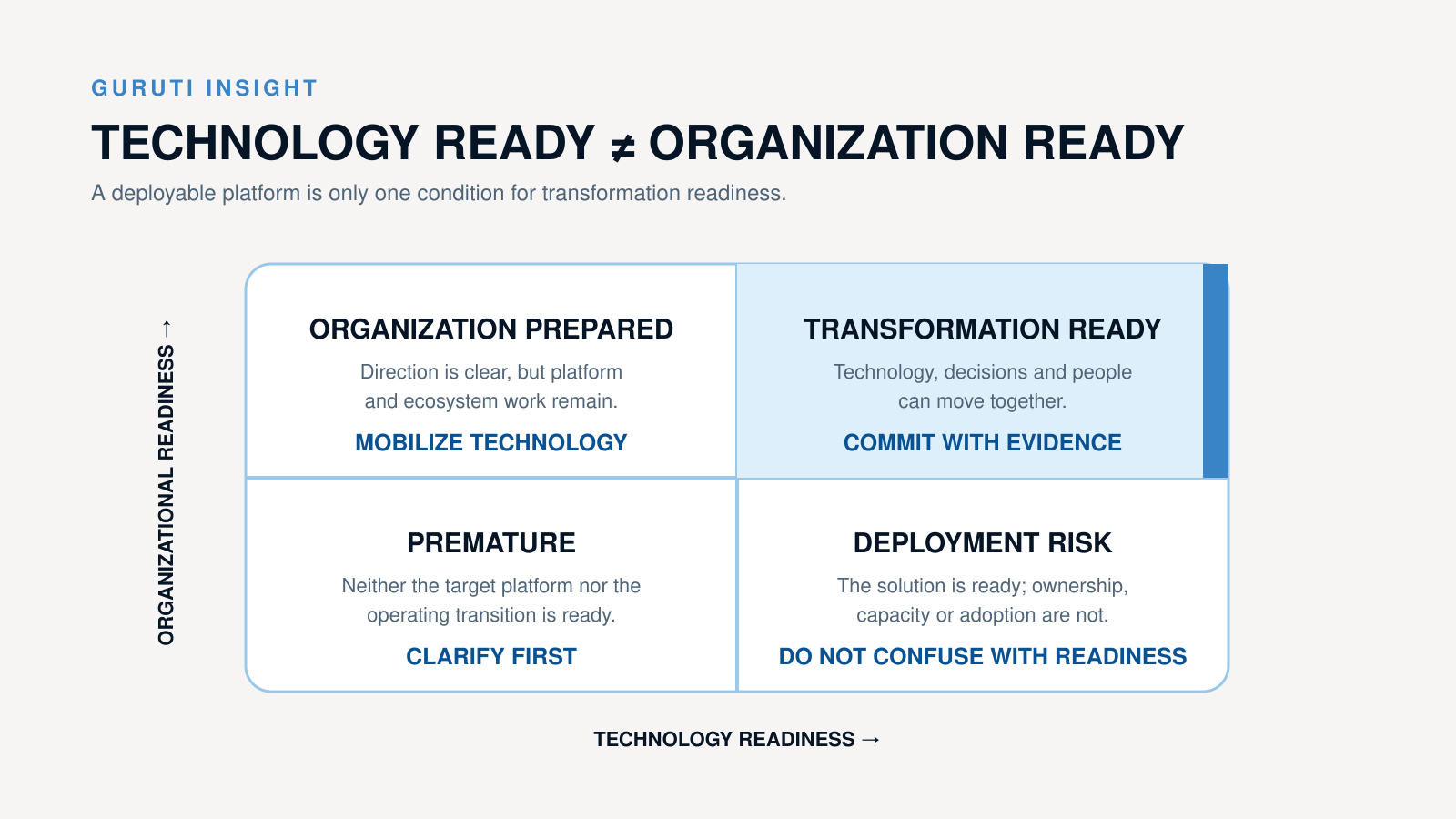
That is why a technically deployable solution can still produce an operationally fragile transformation.
The real readiness question is not:
Can the platform be configured and launched?
It is:
Can the organization make the decisions, absorb the transition and operate the target model confidently from day one?
The following 15 questions are designed for CIOs, hotel technology leaders, operations executives, transformation directors and PMO leaders before scope, timelines and commitments become difficult to change.
1. What business outcome must the transformation produce?
“Move to the cloud” is a technology direction, not a business outcome.
Executives should be able to state what must improve in operational terms: greater consistency across properties, stronger controls, faster onboarding, better data quality, more reliable integrations, clearer decision ownership, reduced dependency on local workarounds or a more scalable operating model.
Evidence of readiness: a concise outcome statement with measurable success indicators and accountable owners.
Risk if absent: the program optimizes installation milestones while every function interprets success differently.
Executive decision: define what the organization must be able to do better, not merely which system it will use.
2. Who owns the transformation outcome?
A PMS program cannot be owned only by IT, the vendor or an implementation partner. Technology can coordinate delivery, but operating decisions belong to the business.
Reservations, Front Office, Revenue, Finance, Distribution, Commercial, Digital, Security and property operations all own part of the future model. Someone must own the whole.
Evidence of readiness: a named executive sponsor, a cross-functional decision body and one accountable transformation lead.
Risk if absent: unresolved business decisions are quietly converted into technical assumptions.
Executive decision: establish end-to-end ownership before design begins.
3. Are decision rights and escalation paths explicit?
Programs slow down when everyone participates but nobody can decide.
The governance model must distinguish global standards, regional decisions, property exceptions, regulatory requirements and configuration choices. It must also define who decides when Operations, Finance, Commercial and Technology want different outcomes.
Evidence of readiness: a decision-rights matrix, escalation thresholds and a maintained decision log.
Risk if absent: delays accumulate, local compromises multiply and configuration becomes inconsistent.
Executive decision: make governance operational, not ceremonial.
4. Do we understand the real operating processes, including exceptions?
Standard operating procedures rarely describe the entire operating reality.
Hotels also depend on exceptions: late changes, no-shows, walk-ins, group movements, payment corrections, folio adjustments, room moves, offline contingencies, posting masters, interface failures and local regulatory practices.
If discovery documents only the happy path, the most difficult operational moments will surface after configuration.
Evidence of readiness: validated current-state journeys, exception scenarios and property-level evidence, not workshops based only on memory.
Risk if absent: the target design appears clean until live operations expose what was never discussed.
Executive decision: validate how work really happens before deciding how it should happen.
5. What should be standardized, and what genuinely needs to remain local?
Multi-property groups need standards, but not every variation is resistance and not every local practice deserves preservation.
Some differences reflect regulation, taxation, market structure or brand operating requirements. Others are historical workarounds that survived because nobody had authority to remove them.
Evidence of readiness: an exception register classifying each variation as regulatory, commercial, operational, temporary or legacy.
Risk if absent: the new PMS either reproduces unnecessary complexity or imposes a global model that cannot operate locally.
Executive decision: standardize intentionally and approve exceptions visibly.
6. Have functional decisions been made before they become system configuration?
Configuration is often treated as a technical activity. In reality, it encodes business policy.
Rate and package logic, routing, deposits, cancellations, postings, taxes, cashiering, invoicing, profiles, groups, permissions and financial mappings all express how the business intends to operate.
Evidence of readiness: approved design decisions with business owners, rationale, dependencies and test criteria.
Risk if absent: consultants configure whichever answer is available first, and the organization discovers its operating model inside a testing defect.
Executive decision: separate business design from system entry while keeping them traceable.
7. Are our data ready to migrate, or merely available?
Data availability is not data readiness.
Guest profiles, company and travel-agent records, reservations, deposits, loyalty references, preferences, AR balances and configuration data may be duplicated, incomplete, obsolete or governed differently across properties.
Migration also creates questions about purpose, retention, access and personal-data handling. These must be addressed with the appropriate privacy, security and legal owners, not improvised inside a technical load plan.
Evidence of readiness: data ownership, quality thresholds, mapping rules, reconciliation controls, retention decisions and rehearsal results.
Risk if absent: the new platform inherits old uncertainty at greater speed and scale.
Executive decision: define what should migrate, what must be corrected and what should not be carried forward.
8. Do we have a complete integration and dependency map?
A PMS is one node in a broader hotel operating ecosystem.
Typical dependencies can include CRS, distribution, booking engine, CRM, loyalty, payments, POS, finance, revenue management, door locks, telephony, guest applications, identity services, BI and local statutory systems.
Modern integration platforms provide APIs, security guidance, implementation documentation and release-readiness information. That capability does not remove the organization’s responsibility to understand each business flow, system of record, failure mode and support boundary.
Evidence of readiness: a business-flow integration map showing direction, ownership, criticality, data objects, timing, reconciliation and fallback.
Risk if absent: interfaces pass isolated technical tests while the end-to-end operating process still fails.
Executive decision: govern integrations as business capabilities, not as a list of connections.
9. Are payment, privacy, security and regulatory controls designed into the target model?
Hotels process personal, financial and payment data across multiple systems and parties.
PCI DSS establishes baseline technical and operational requirements for protecting payment account data. Data-protection obligations also require deliberate decisions about access, purpose, retention and handling of personal information.
These controls cannot be bolted onto the deployment after the operating design has been agreed.
Evidence of readiness: approved payment architecture, access model, data-handling rules, security ownership and control-testing scope.
Risk if absent: a configuration or integration decision introduces exposure that is costly to redesign late.
Executive decision: involve security, privacy, finance and compliance owners during design, not only at final approval.
10. Can the organization resource the program without weakening live operations?
The people who know the operation best are usually already running it.
A transformation needs their knowledge, but repeatedly borrowing operational experts without protecting their capacity creates two risks: weak design and deteriorating daily performance. The same capacity problem affects operational enablement: learning owners, trainers, super-users and support teams need protected time, appropriate environments and enough preparation to translate the target model into competent execution.
Evidence of readiness: named functional and learning owners, backfill or capacity protection, realistic decision calendars, prepared trainers and super-users, usable practice environments and clear responsibilities across central and property teams.
Risk if absent: subject-matter experts become bottlenecks, decisions are delegated to whoever is available and fatigue appears before rollout begins.
Executive decision: treat internal capacity as part of the investment, not as free project inventory.
11. Does the rollout model reflect operational reality?
Pilot selection, wave composition and cutover timing are business decisions.
A convenient pilot is not necessarily a representative pilot. A small property may hide complexity; a flagship may carry excessive risk. Wave design must consider market, language, regulation, operating model, integration pattern, seasonality, team maturity and support coverage. Entry criteria should also confirm that affected roles have completed the right preparation, practised representative scenarios and know where to obtain support. A wave is not ready merely because configuration and data are ready.
Readiness should not be averaged across an entire property or wave. Through the TMM™ lens, stakeholder groups may be anchored to the current model, uncertain about the transition, exploring the future state, actively adapting or ready to lead others. Each condition requires a different response, from credible rationale and trust-building to practice, feedback, reinforcement or empowerment.
Evidence of readiness: explicit pilot criteria, wave archetypes, technical and human entry/exit gates, cutover rehearsals, role-based learning prerequisites and stabilization thresholds.
Risk if absent: early success creates false confidence, while later waves encounter complexity the pilot never tested.
Executive decision: design the rollout as a learning system, not a calendar.
12. How will critical knowledge survive from design through stabilization?
Long programs lose context between phases.
Decisions are made during discovery, interpreted during configuration, challenged during testing and rediscovered during hypercare. If ownership changes or external specialists rotate, the reasons behind the design can disappear even when documents remain. A folder of training files does not solve this problem if teams cannot identify the current source, understand what changed or trace the operational reason behind the guidance.
Evidence of readiness: decision traceability, accountable process owners, a controlled and versioned knowledge source, structured handovers, retained functional leadership and knowledge-transfer checkpoints.
Risk if absent: each wave pays again to relearn what the previous wave already discovered.
Executive decision: manage knowledge continuity as a delivery control, not an administrative task.
13. Do people understand how their decisions and behaviours must change?
System access is not readiness.
The transition may alter who owns a reservation, when a booking becomes operational, how an exception is approved, where a correction is made, which system is authoritative and how corporate and property teams collaborate.
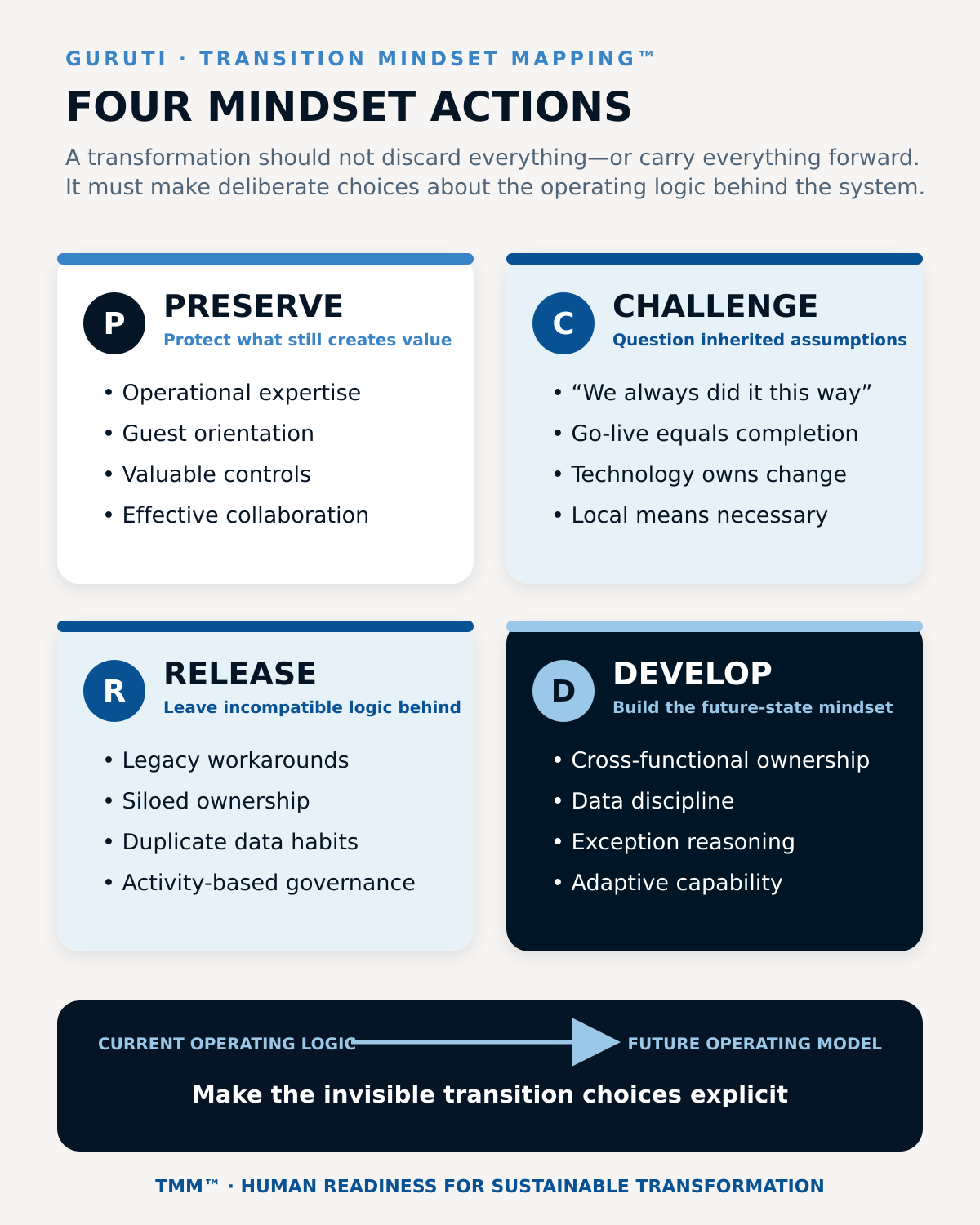
Through the TMM™ lens, readiness begins by understanding the current operating mindset: the assumptions, habits and workarounds people use to keep the hotel running today. Only then can the program define the behaviours and decision patterns required by the target model.
That transition should make four deliberate choices:
- Preserve the operational expertise, guest orientation, controls and practices that continue to create value.
- Challenge assumptions such as “we have always done it this way,” “go-live means completion” or “technology owns the transformation.”
- Release incompatible workarounds, siloed ownership, duplicate data habits and decision patterns inherited from the previous system.
- Develop cross-functional ownership, data discipline, exception reasoning, adaptive capability and the habits required by the future operating model.
Evidence of readiness: role-impact maps, stakeholder transition risks, explicit future behaviours, scenario-based transition guidance and local readiness feedback.
Risk if absent: teams reproduce the old operating model inside the new platform.
Executive decision: design the human transition alongside the system, not after it.
Learning architecture is a deployment control
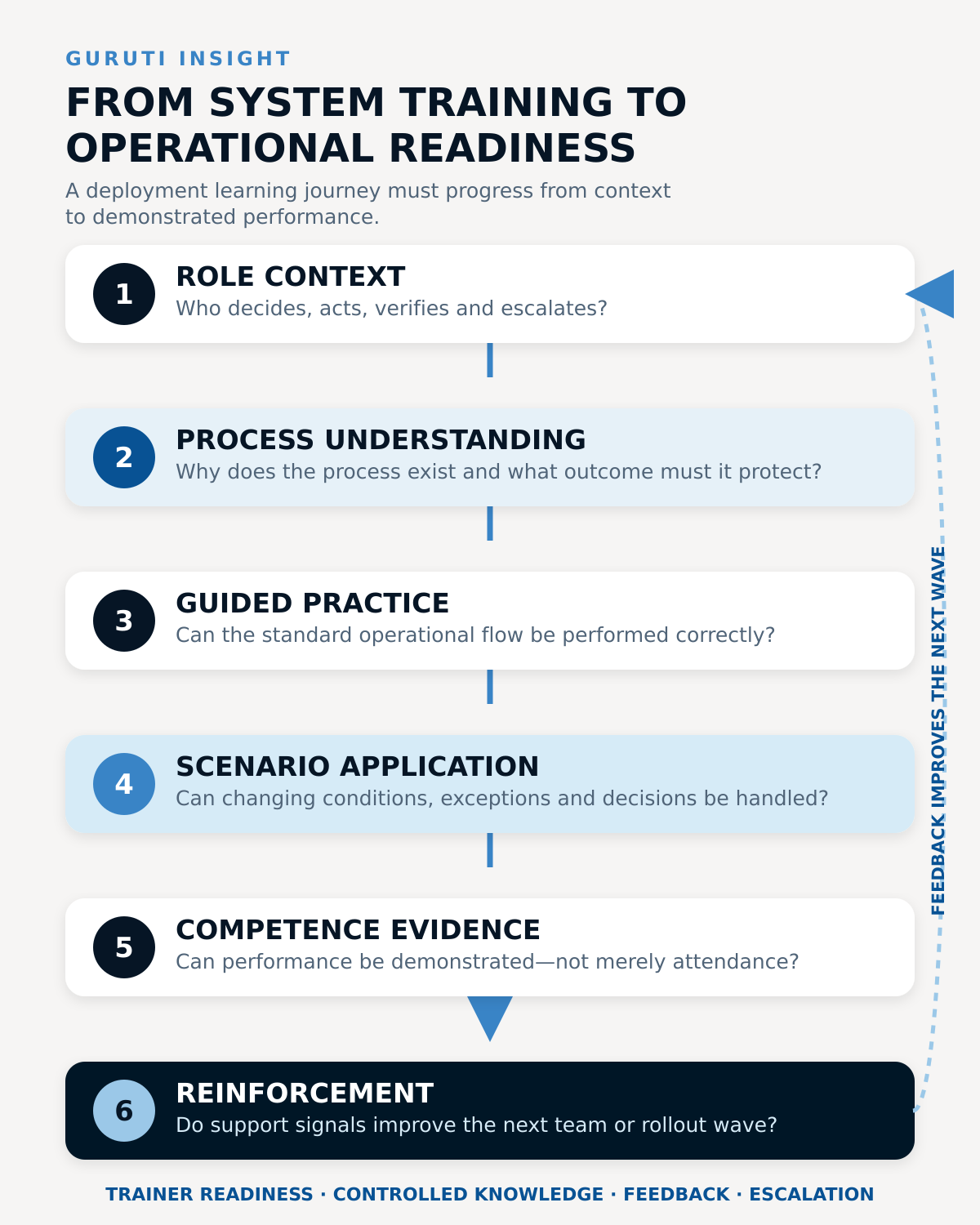
A training calendar answers when sessions will happen. A learning architecture answers how different roles will progress from awareness to confident operational performance.
It connects role segmentation, process understanding, guided practice, realistic scenarios, trainer readiness, competence evidence and post-go-live reinforcement. It also creates a controlled feedback loop: difficulties detected during practice, testing or stabilization should improve the guidance, scenarios and support model used by the next team or rollout wave.
This matters because people do not operate production systems by repeating a demonstration. They interpret conditions, make decisions, manage exceptions, verify outcomes and escalate when a situation exceeds their authority or knowledge.
Evidence of readiness: a role-based learning journey showing prerequisites, expected capabilities, practice opportunities, knowledge ownership, validation points and reinforcement after launch.
Risk if absent: courses are delivered as isolated events, while each property or team reconstructs operational understanding under live pressure.
Executive decision: design learning as part of the deployment architecture, not as a communication activity attached to it.
14. Are we building operational competence or only delivering training?
Completing a course does not prove that someone can handle a live arrival queue, resolve a payment issue, manage a group change or recover from an interface failure.
Training must connect system knowledge with operating scenarios, role decisions, controls and escalation paths. The objective is not click-sequence recall. People should be able to recognize the process, explain its purpose and impact, perform standard activities, reason through changing conditions, adapt their response and recognize when escalation is required.
The learning response should reflect the actual transition barrier. A team that does not understand the reason for change needs orientation. A group that doubts the programme needs credible evidence and consistent leadership. People who understand but cannot yet perform need practice and feedback. Those already adapting need reinforcement, autonomy and recognition, not the same generic course again.
Evidence of readiness: role-based learning, prepared trainers, progressive knowledge checks, realistic scenario practice, demonstrated competence, super-user capacity, floor support and reinforcement after go-live.
Risk if absent: completion statistics look healthy while confidence collapses under real operating pressure.
Executive decision: measure readiness through demonstrated performance, not attendance.
15. How will we know the new operating model has been adopted and is creating value?
Go-live confirms that the platform is available. It does not confirm that the transformation has succeeded.
Executives need measures that connect system use with operational outcomes: process consistency, exception volumes, data quality, reconciliation reliability, support demand, user confidence, decision speed and the business outcomes defined at the start. Learning evidence should form part of this picture: repeated questions, failed scenarios, recurring escalations and support patterns can expose an unclear process, weak guidance or an unresolved design decision, not simply a user problem.
TMM™ treats adoption as the point at which the future state becomes normal operations. Progress therefore needs to be read across understanding, belief, trust, practical readiness, ownership, adaptability, reinforcement and adoption, not compressed into one reassuring engagement or completion score.
Evidence of readiness: a benefits baseline, adoption and competence indicators, operational KPIs, a learning-to-support feedback loop, review cadence and owners for corrective action.
Risk if absent: stabilization becomes an open-ended support phase and expected value remains anecdotal.
Executive decision: define value realization before deployment, then govern it after launch.
Readiness is an evidence threshold, not an average score
Organizations are rarely equally ready across every dimension.
Technology may be contracted while ownership remains unclear. Data may be available while quality and retention decisions are unresolved. Training may be scheduled while future role behaviours are undefined.
That means readiness should not be reduced to one reassuring percentage.
A critical weakness in ownership, functional design, data, payments, operational continuity or human readiness can outweigh several areas of progress. The purpose of a readiness review is not to produce a green dashboard. It is to make unresolved decisions visible while they can still be addressed.
The executive conclusion
A PMS transformation succeeds when technology, operating decisions and human readiness move together.
The platform matters. So do the implementation partner, integrations and deployment plan. But none of them can compensate for missing ownership, unresolved functional decisions or an organization that is not prepared to operate the future model.
Before committing to scope, timing or rollout, leadership should be able to answer these 15 questions with evidence, not optimism.
That is the difference between installing a PMS and building a more capable hotel operating system.
Discuss your hospitality technology transformation
GURUTI helps hotel organizations connect business design, PMS and ecosystem decisions, governance, deployment and human readiness, from strategy through operational adoption.
Explore Hospitality Technology Transformation