
RevPAR is not obsolete. It is incomplete for the relationship hotels are now trying to build.
Revenue per available room remains one of hospitality’s most useful measures of inventory performance. It connects occupancy and rate, supports benchmarking and gives operators a disciplined view of how rooms are performing in a defined period.
But a room-night is not a guest relationship.
RevPAR cannot tell a hotel whether it is repeatedly paying to reacquire the same traveller, whether a stay created trust, whether service friction weakened future demand, whether the guest will return through a direct channel, or whether the organization can even recognize that person across properties and systems.
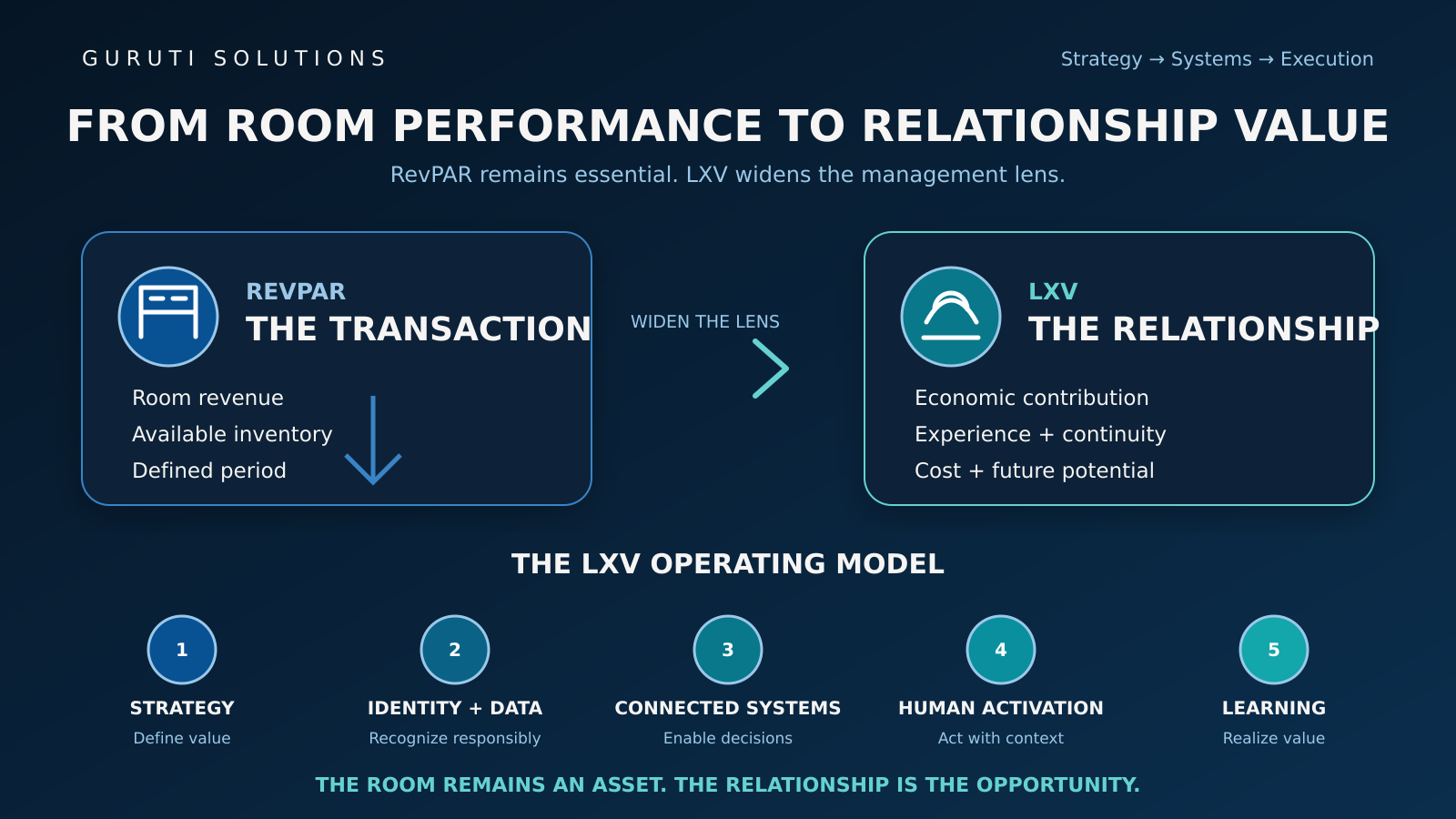
RevPAR measures the performance of available rooms. Lifetime Experience Value asks whether the enterprise is building relationships capable of creating value over time.
That distinction matters because hospitality increasingly competes through connected experiences, relevant service and the ability to learn across the guest lifecycle. Yet many hotels still manage rooms, channels, profiles, interactions and operations as separate domains.
Guruti uses Lifetime Experience Value (LXV) as a management framing for closing that gap. It is not a standardized industry KPI, and it should not replace RevPAR, GOPPAR, TRevPAR or a sound customer-lifetime-value model. It is a wider operating lens: one that connects guest economics with relationship continuity, experience, cost-to-serve, future potential and the capabilities required to act.
What RevPAR sees and what it cannot
RevPAR answers an essential question: how effectively did the hotel monetize its available room inventory during a period?
Its strength is also its boundary. The unit of analysis is the available room, not the evolving relationship with the guest. RevPAR does not, by itself, reveal:
- the full cost of acquiring and reacquiring demand;
- the contribution from food and beverage, spa, events or other services;
- repeat behaviour across properties, brands or channels;
- the operational cost of friction, complaints and recovery;
- the effect of relevance, trust and advocacy on future behaviour;
- or whether fragmented systems are hiding one relationship behind multiple records.
Other hotel metrics extend the financial picture. They should. But even a richer revenue or profit measure does not automatically explain why the relationship developed as it did, what the organization learned from it, or what should happen next.
This is not a measurement failure. It is a management-design gap.
Defining Lifetime Experience Value
Lifetime Experience Value is Guruti’s lens for understanding and improving the value created across the complete guest relationship, for the guest and for the hospitality business.
The word lifetime expands the horizon beyond a single stay. Experience recognizes that future economic behaviour is influenced by what the organization actually delivers. Value requires commercial discipline: revenue matters, but so do acquisition cost, service effort, retention, directness, ancillary contribution and future potential.
LXV therefore has four connected dimensions.
1. Economic contribution
Room revenue remains fundamental, but the relationship may also generate ancillary spend, longer or more frequent stays, cross-property activity and lower acquisition cost. A high-revenue stay acquired through an expensive channel and followed by substantial recovery effort does not have the same economics as a trusted repeat relationship.
2. Relationship continuity
Can the hotel recognize the same guest over time? Does preference strengthen? Does the guest return intentionally, engage directly or remain dependent on price-led reacquisition? Continuity changes both the commercial opportunity and the quality of information available for future decisions.
3. Experience, trust and advocacy
Experience influences what happens after checkout. Relevance, consistency, service recovery and human judgment can strengthen trust; disconnected handoffs can erode it. Advocacy and recommendation are not decorative brand outcomes. They are signals that the experience may be generating value beyond the completed transaction.
4. Cost, friction and future potential
Historical revenue is only part of the picture. The organization must also understand commissions, promotional dependency, cost-to-serve, operational exceptions and the likelihood of future value. LXV is not about rewarding every frequent guest indiscriminately. It is about making better choices with a more complete view.
LXV is not a score. It is an operating-model question
The fastest way to weaken LXV is to treat it as another dashboard project.
A hotel can commission an advanced model and still be unable to recognize the same person across the PMS, CRS, booking engine, CRM, loyalty platform, POS, payments, reputation tools and operational applications. It can predict intent but fail to put useful context in front of the colleague serving the guest. It can produce segments that no operating process knows how to activate.
The real question is not “Can we calculate a more sophisticated guest score?” It is:
Can our strategy, systems and people work as one operating environment around the relationship we want to create?
That is why LXV belongs within Transformation Strategy & Operating Models, not inside a single commercial, technology or guest-experience team.
The five capabilities behind an LXV operating model
1. A strategic definition of value
A luxury resort, an urban business hotel, an extended-stay operator and a multi-brand portfolio should not define a valuable relationship in exactly the same way. The guest proposition, business model and strategic priorities must determine what the organization wants to learn and influence.
Start with decisions, not data fields. Which relationships merit protection? Where does directness matter? Which experiences create differentiation? What behaviour would represent stronger mutual value?
2. Reliable identity, consent and data foundations
Relationship management is impossible when one guest becomes six disconnected profiles. Identity resolution, preference management, consent, data quality and governance are not back-office hygiene; they are prerequisites for continuity.
More data is not the goal. Useful, governed and explainable data is. This is where Enterprise Systems, Integration, Data & AI becomes inseparable from guest strategy.
3. Connected systems and decision flows
Integration should be designed around decisions and moments that matter, not around the ambition to connect everything. What should be known during booking, pre-arrival, check-in, the stay, recovery and post-stay? Which system is authoritative? Who can act? What happens when the data is uncertain?
A technically connected architecture can still create an operationally disconnected experience. LXV exposes the handoffs where information exists but does not travel, arrives too late or cannot be used.
4. Human activation at the point of service
McKinsey’s consumer research found that 71% of consumers expected personalized interactions and 76% became frustrated when they did not receive them. In hospitality, however, relevance cannot be reduced to automated targeting. A preference recognized without context can feel mechanical; a well-timed act of human judgment can create disproportionate trust.
Frontline colleagues do not need another abstract score. They need concise context, clear decision rights and practical ways to respond. The transition from insight to behaviour is a Human Readiness, Change & Adoption challenge as much as a data challenge.
5. Learning, governance and value realization
Which interventions genuinely change behaviour? Which offers simply subsidize demand that already existed? Where does personalization remove friction, and where does it create it? Which signals are predictive, and which merely look impressive in a presentation?
An LXV operating model needs owners, hypotheses, tests, feedback loops and commercial accountability. It should become more useful as the organization learns, not more complex because more data becomes available.
Direct booking is a beginning, not the relationship
Direct distribution can lower dependency on intermediaries, improve control of the commercial relationship and create better opportunities to understand guest behaviour. Those are strategically important advantages.
But a direct booking does not automatically create loyalty.
The stay must still deliver. The hotel must recognize relevant context, connect information responsibly, equip teams to act and earn the right to continue the relationship after departure. If the direct channel promises recognition but operations deliver anonymity, the organization has improved acquisition mechanics without improving relationship value.
This is why distribution, CRM, loyalty, data and property operations must be treated as one Hospitality Technology Transformation agenda.
AI can estimate value. It cannot own the experience
AI and predictive analytics can help identify behavioural patterns, estimate propensity, recommend next actions, detect disengagement and prioritize intervention. Used well, they can make large and fragmented guest portfolios more intelligible.
But prediction is not permission, and a model is not judgment.
The organization still needs to understand why a signal matters, whether the proposed action is appropriate and how it will affect the experience. Responsible LXV combines three forms of intelligence:
- Data intelligence: what patterns and evidence reveal.
- Operational intelligence: how the hotel and its processes actually work.
- Human intelligence: what context, emotion and the immediate situation require.
The strongest hospitality model is not data instead of people. It is better-informed people operating through better-connected systems.
A practical path from concept to operating reality
Hotels do not need to begin with a perfect enterprise-wide formula. They need to begin with a decision worth improving.
- Choose a relationship or use case. For example, repeat leisure guests, high-potential direct guests, cross-property recognition or service recovery.
- Define value and behaviour. State what better mutual value would look like and which decisions could influence it.
- Map the current journey and information flow. Identify systems, owners, data gaps and operational handoffs.
- Select a small set of signals. Use only the information required to improve the chosen decisions.
- Design the human and system response. Clarify who acts, when, through which channel and within what boundaries.
- Test for incremental value. Separate genuine behavioural change from activity that would have happened anyway.
- Scale what works. Extend the model only after the operating foundation is reliable.
This sequence protects the transformation from becoming a data programme in search of a business problem.
Ten questions for hospitality leaders
- Can we recognize the same guest consistently across channels, stays and properties?
- Do we understand relationship economics beyond room revenue and the latest transaction?
- Where are we repeatedly paying to reacquire guests we should already know?
- Can we connect commercial signals with operational experience and service recovery?
- Which guest decisions would improve if teams had better context?
- Are our data permissions, ownership and governance clear enough to act responsibly?
- Do our systems support the journey, or merely store separate fragments of it?
- Can frontline teams use the insight without extra complexity or cognitive overload?
- How do we distinguish incremental value from correlation or subsidized behaviour?
- Who owns continuous improvement of the complete guest relationship?
If several answers are unclear, the immediate priority is probably not an LXV algorithm. It is the operating foundation that would make one credible.
Beyond the room, towards the relationship
RevPAR remains indispensable because hotels must understand how inventory performs. LXV does a different job. It asks whether the enterprise can understand, serve and grow the relationship surrounding that inventory.
That requires more than a dashboard. It requires a strategic definition of value, a connected data and systems foundation, operational decision flows, prepared people and governance that learns.
The room remains an asset. The relationship is the opportunity.
For hospitality leaders, the progression is clear:
Strategy → Systems → Execution.
Define the relationship the business wants to create. Build the operating environment capable of recognizing and supporting it. Then enable people to convert insight into a better experience and measurable value.
That is the purpose of Lifetime Experience Value: not to add another metric, but to make the complete guest relationship manageable.
Frequently asked questions
What is Lifetime Experience Value (LXV)?
LXV is Guruti’s management framing for understanding and improving the economic, relational and experiential value created across the complete guest relationship. It connects revenue, acquisition cost, continuity, experience, operational effort and future potential.
Does LXV replace RevPAR?
No. RevPAR measures room-inventory performance and remains essential. LXV complements it by examining the relationship and operating capabilities that sit beyond an individual room-night.
How is LXV different from Customer Lifetime Value?
Customer Lifetime Value typically estimates the economic value of a customer over time. LXV deliberately widens the management lens to include experience, trust, operational friction, human execution and the enterprise capabilities required to recognize and influence the relationship.
Is LXV a single hotel KPI?
It should not begin as one universal score. Different hospitality models define value differently. LXV is first an operating discipline; metrics and models should follow the strategy and decisions involved.
What technology is required?
The answer depends on the use case. Reliable identity, governed data and useful connections among commercial and operational systems matter more than acquiring another platform without a defined decision model.
Where should a hotel start?
Choose one valuable relationship decision, map the data and operating flow behind it, define a small set of signals, test a practical response and measure whether it creates incremental value.
Ready to connect guest strategy, systems and execution? Book a Strategy Session
Sources and further reading: IDeaS, Hotel Revenue Management Terminology; McKinsey, The value of getting personalization right—or wrong—is multiplying; Oracle Hospitality and Skift, Hospitality in 2025.