
A hotel can modernize its PMS, CRS, RMS, CRM, payments, distribution stack and reporting layer, and still operate inside a destination that remains fragmented.
That is the paradox at the center of smart tourism.
The hospitality industry has spent years making individual properties more connected. Destinations are now building smart-city platforms, tourism-intelligence systems, data spaces and digital services of their own. Yet the strategic question is no longer simply whether each organization has modern technology.
It is whether the systems, organizations and decisions across the destination can work together.
A connected hotel is not yet a connected destination. A Smart City platform is not yet a transformed tourism ecosystem.
The next frontier of hotel technology may therefore not be another system inside the hotel. It may be the ability of the hotel to participate intelligently in the destination around it.
For destination leaders, the challenge is the mirror image: collecting more urban and tourism data does not automatically improve how hotels, public services, mobility providers, attractions, businesses and residents operate.
The missing layer is an operating model.
A useful way to frame that operating model is:
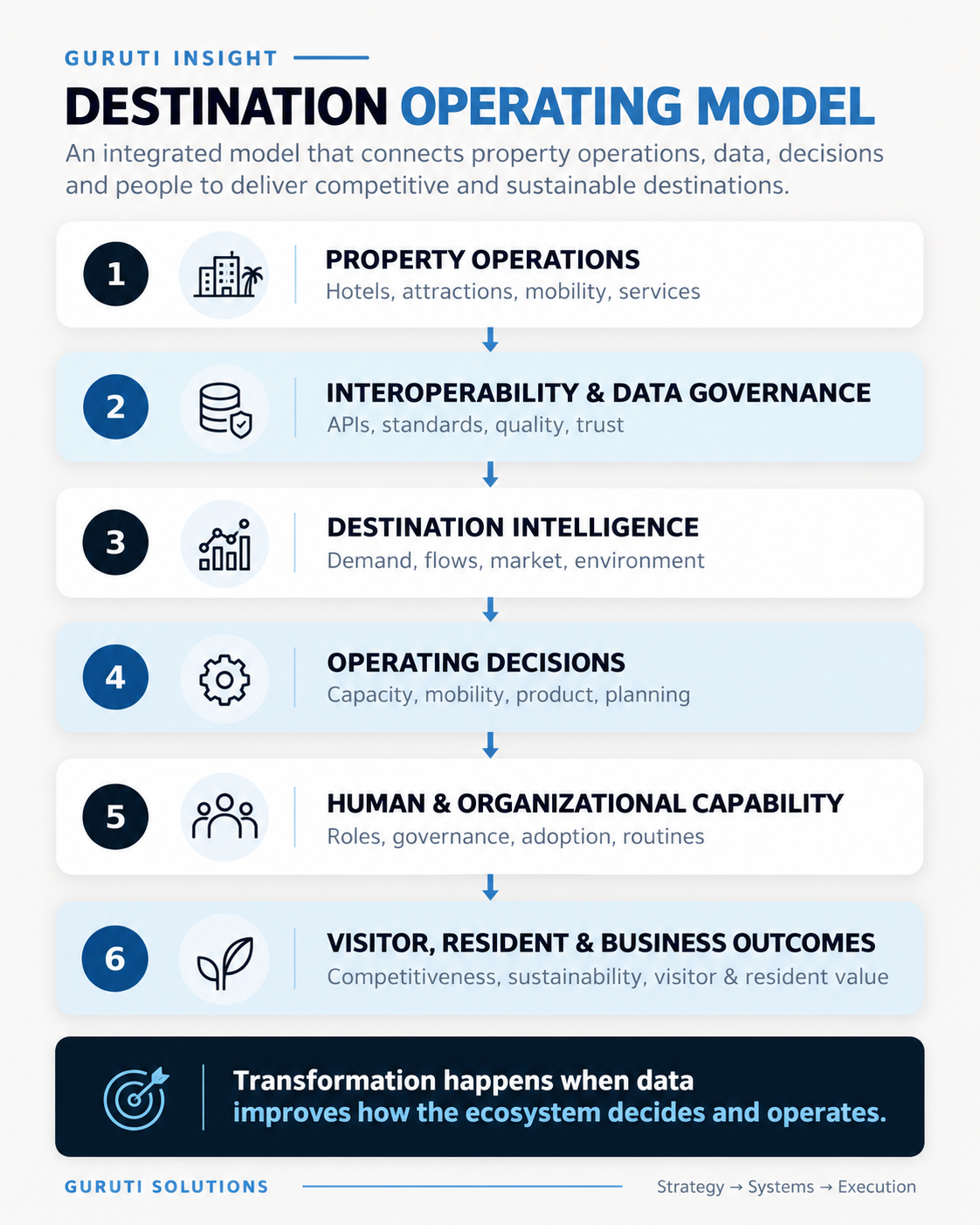
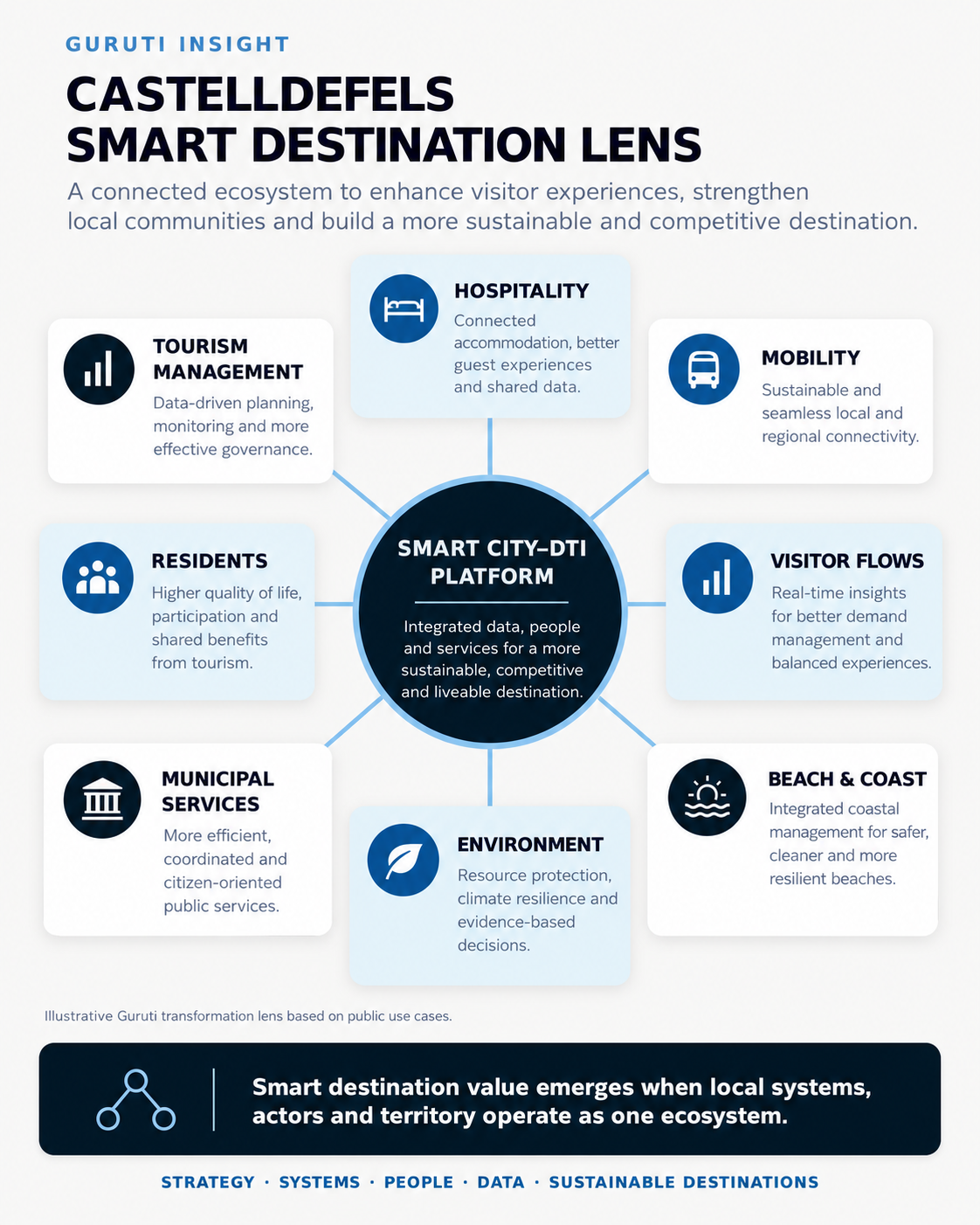
Property Operations → Interoperability & Data Governance → Destination Intelligence → Operating Decisions → Human & Organizational Capability → Visitor, Resident & Business Outcomes
That chain matters because digitalization and transformation are not the same thing.
Technology can connect systems. Transformation aligns the decisions, responsibilities, behaviours and operating logic around the value those systems are supposed to create.
Smart City, Smart Hotel and Smart Destination Are Different Problems
The terms are often used as if they describe the same transformation at different scales. They do not.
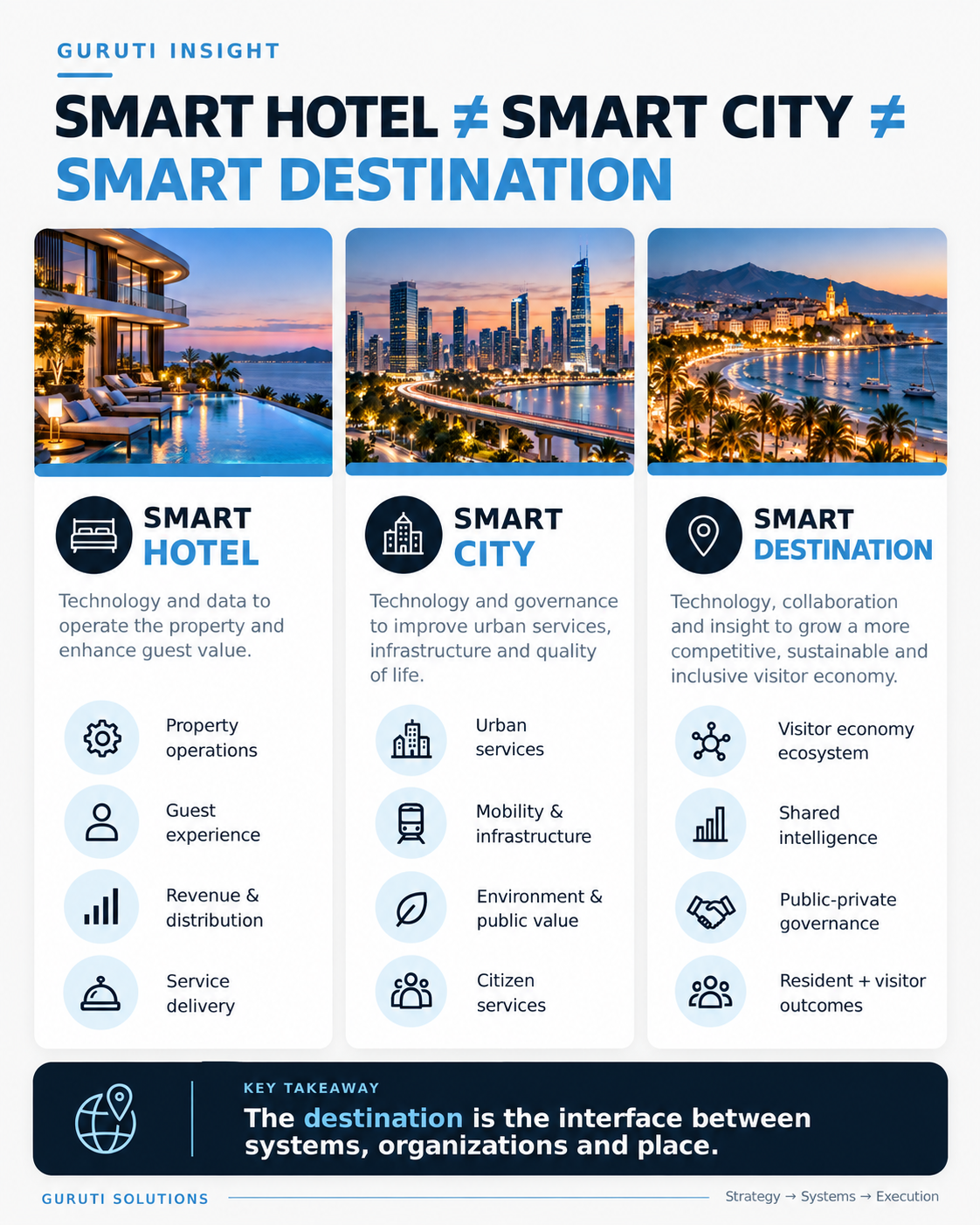
A Smart City is concerned with the functioning of the wider urban environment: mobility, public services, infrastructure, energy, environment, safety, access, information and quality of life.
A Smart Hotel focuses on the operating environment of a hospitality business: rooms, guests, reservations, rates, distribution, payments, service, maintenance, staffing, commercial performance and the technology that supports them.
A Smart Destination sits across organizational boundaries.
It must consider the visitor economy as an ecosystem involving public authorities, accommodation providers, attractions, mobility, events, restaurants, local businesses, technology platforms, residents and visitors themselves.
Spain’s Destinos Turísticos Inteligentes model reflects this broader management challenge through five recurring dimensions: governance, innovation, technology, sustainability and accessibility.
That distinction is important.
A destination can deploy intelligent parking, sensors, digital signage, apps and analytical platforms without creating a coherent tourism operating model.
A hotel can implement a cloud PMS, advanced revenue technology and real-time reporting without contributing meaningfully to destination intelligence.
Both may be technologically advanced. Neither is necessarily transformed.
Think of the Destination as an Operating System
A destination is not just a location.
It is a system of demand, supply, infrastructure, institutions, services, technology, people and decisions interacting continuously in the same place.
That is why the “destination as an operating system” lens is useful.
Demand arrives through different markets, seasons and channels.
Hospitality businesses translate that demand into accommodation, service and commercial activity.
Public infrastructure influences how easily people move, access the destination and use shared resources.
Transport, beaches, events, attractions, restaurants and local services shape the experience beyond the hotel.
Institutions decide how the territory is managed.
Technology increasingly makes these interactions visible.
But the quality of the destination depends on the interfaces between these components, not only the quality of each component individually.
This perspective also underpins Guruti’s applied business-education work in destination management: before asking what a destination should do next, it is useful to make the interdependencies between demand, supply, technology, operations and governance visible.
The executive implication is simple:
Transformation happens in the interfaces.
The same principle that applies inside an enterprise applies at destination level.
If systems connect but organizations do not, the destination remains fragmented.
If data becomes available but decision rights remain unclear, dashboards multiply while operating behaviour stays the same.
If strategy promotes sustainability but mobility, visitor flows, commercial incentives and infrastructure decisions are managed separately, sustainability remains an aspiration rather than an operating condition.
The Missing Link: Property Systems Are Part of Destination Intelligence
Hotels are important service providers inside a destination.
They are also important producers of operational signals.
A property-management and commercial ecosystem can generate information about:
- occupancy;
- booking pace;
- length of stay;
- demand patterns;
- market mix;
- seasonality;
- revenue performance;
- cancellations;
- arrival and departure patterns;
- distribution behaviour.
Historically, much of that intelligence has remained inside individual properties, hotel groups, technology providers or market-data products.
That boundary is beginning to change.
In June 2026, SEGITTUR and the Instituto Tecnológico Hotelero announced an initiative to integrate hotel data into Spain’s Plataforma Inteligente de Destinos. The initial implementation involved hotels in Barcelona and Mallorca.
The participating hotel connects data from its PMS to a hotel analytics environment. Aggregated information can then contribute to a wider market and destination view, while the hotel receives comparative intelligence about its own performance and the destination around it.
The published examples include indicators such as occupancy, revenue, ADR and RevPAR.
This matters because it demonstrates a practical shift in the smart-destination model:
property data is becoming part of destination intelligence.
But the interesting question is not whether the connection is technically possible.
The interesting question is what operating model makes that connection useful and sustainable.
Data Sharing Is Not an Integration Project. It Is a Governance Model.
A destination data ecosystem cannot be built on the assumption that every organization should simply expose more information.
Hotels have legitimate concerns about commercial sensitivity, competitive information, customer privacy, security and control.
Public authorities have responsibilities around governance, transparency, public value and appropriate use of information.
Technology providers manage data structures and interfaces that may differ significantly across systems.
Small businesses may lack the technical capability to participate at the same level as large hotel groups.
The challenge is therefore not “how do we connect everything?”
It is:
what information should be exchanged, at what level, under what rules, for what purpose and in return for what value?
That requires decisions about:
- aggregation;
- access rights;
- semantic standards;
- data definitions;
- quality;
- ownership;
- cybersecurity;
- confidentiality;
- reciprocity;
- retention;
- acceptable use.
It also requires trust.
Hotels will not participate sustainably in a destination data ecosystem simply because a platform exists. They participate when the operating model creates value on both sides.
That value exchange may include better market context, improved demand intelligence, stronger destination planning, more effective event coordination, more accurate capacity decisions or more timely understanding of visitor behaviour.
Research on tourism-company adoption of smart-destination models reinforces this point. Technological factors matter, but organizational and environmental factors, including perceived usefulness and commitment to local development, also influence whether businesses support and participate in smart-destination initiatives.
Connectivity is therefore only one layer of adoption.
The wider transformation depends on governance and perceived value.
Barcelona: When Hotel Data Becomes Destination Intelligence
Barcelona provides a useful lens because destination intelligence already operates at significant scale.
The Observatori del Turisme a Barcelona: ciutat i regió functions as a statistical, knowledge and tourism-intelligence platform for Barcelona city and the wider destination region. Its current work includes market monitoring, tourist profiles, labour-market information, tourism activity and recurring destination perspectives.
This creates an established intelligence environment around the destination.
The 2026 SEGITTUR–ITH hotel-data initiative adds another important layer.
Hotels in Barcelona are among the first participants in a model that connects PMS-originated performance information into a wider destination-intelligence environment.
That creates a two-way logic:
hotel operations → destination intelligence
and
destination intelligence → better hotel context
The hotel contributes controlled operational signals.
The destination develops a richer picture of demand and market behaviour.
The hotel receives a clearer comparative view of its position within the destination.
This is materially different from the traditional model in which the destination publishes periodic statistics and each hotel independently interprets its own data.
It points toward a more dynamic relationship between property systems and place-based intelligence.
That does not mean Barcelona, or any other destination, has “solved” smart tourism.
It means the boundary between enterprise data and destination data is becoming strategically important.
Castelldefels: Where Smart City and Destination Management Converge
Castelldefels offers a different but highly relevant case.
It is not a global megacity.
It is a coastal destination inside the Barcelona metropolitan environment, where tourism, residents, beach use, mobility, natural assets, local commerce and metropolitan visitor flows interact within a relatively compact territory.
That makes it useful as a model for many real-world destinations.
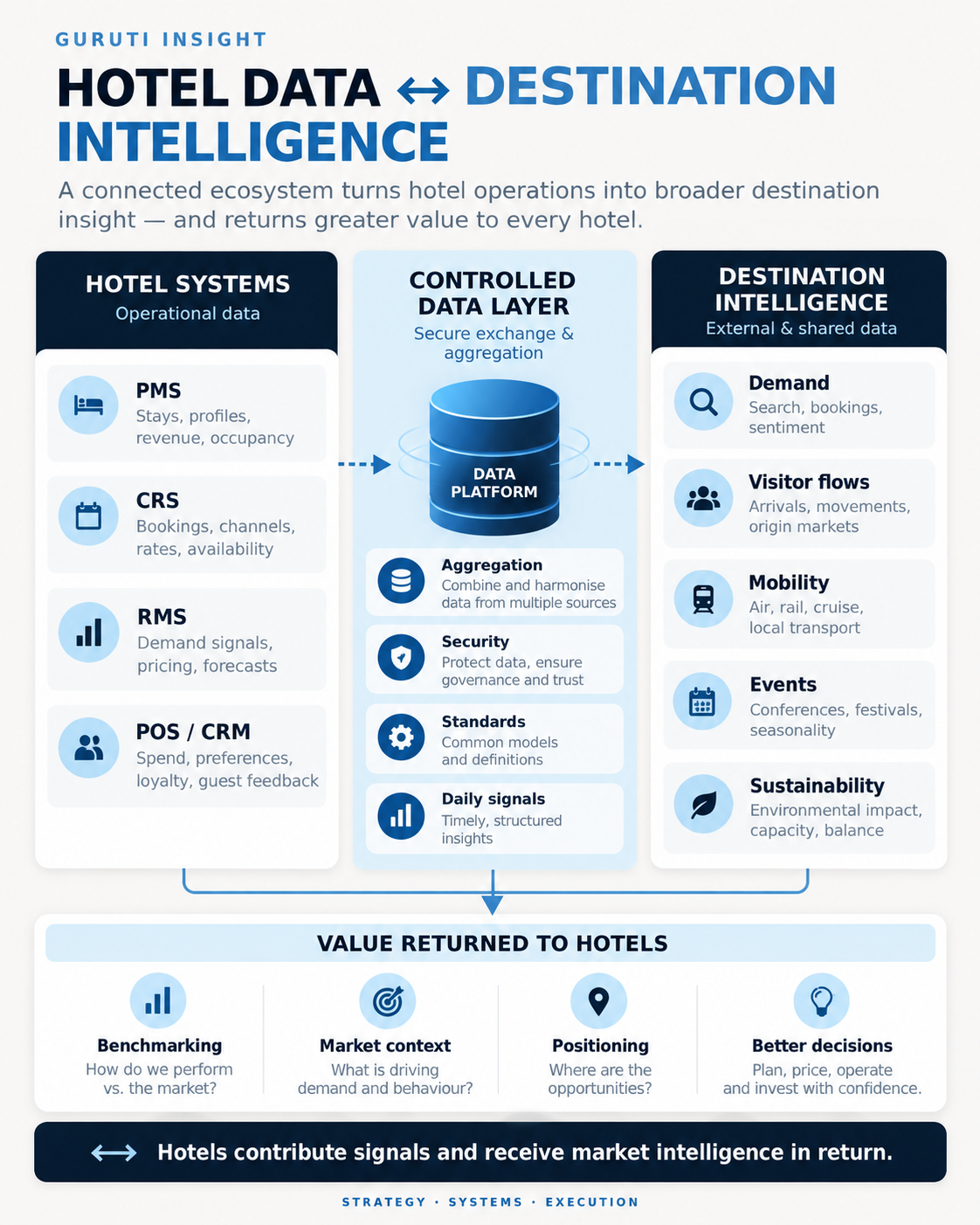
In 2026, Castelldefels is deploying a Smart City–DTI platform supported through Next Generation EU and SEGITTUR.
Municipal information describes an architecture based on open standards that integrates data from sensors, internal municipal systems and external/open sources.
Current use cases include:
- parking;
- traffic and mobility;
- people flows;
- environmental conditions;
- geographic-information systems;
- digital-twin capabilities;
- citizen/destination perception;
- DTI performance information.
The city is also participating in the PSTD Costa Barcelona Delta Llobregat, which combines sustainable destination development with digital transition and tourism-intelligence objectives.
This combination is important because it shows how the smart-city and smart-destination agendas can converge.
A parking system is an urban-management tool.
During peak tourism periods, it also becomes part of the visitor experience.
People-flow analysis can support crowd and mobility management.
It can also help understand how visitors use the destination.
Environmental monitoring can support public services and resilience.
It can also influence how tourism pressure is managed around coastal and natural assets.
The same infrastructure can therefore serve residents and visitors, but only if the operating model connects the information to the right decisions.
Castelldefels is especially interesting because the transformation challenge is not abstract.
The territory must balance tourism, metropolitan access, beach demand, environmental assets, local life and economic activity.
That is exactly the kind of environment where “smart” should mean better coordination, not simply more technology.
Sustainability Is an Operating Constraint, Not a Marketing Label
Smart tourism is sometimes discussed as if sustainability were one more feature in a digital-transformation programme.
It should be treated as an operating constraint.
SEGITTUR’s 2026 direction for the next stage of Spain’s DTI model reinforces sustainability and innovation around two connected outcomes: improving resident quality of life and improving the visitor experience.
That matters because destination success cannot be evaluated only through visitor growth.
A destination may increase demand while simultaneously creating pressure on mobility, housing, public space, natural assets, infrastructure or resident acceptance.
Destination intelligence becomes strategically useful when it helps leaders understand those trade-offs.
Examples include:
- where visitor flows are concentrating;
- how tourism interacts with mobility peaks;
- when public services face capacity pressure;
- how events change demand patterns;
- where environmental conditions require different operating responses;
- how visitor movement can be distributed more effectively;
- how infrastructure and service investments should be prioritized.
The point is not that every sustainability challenge has a technological solution.
It does not.
The point is that better information can make the operating consequences of tourism more visible.
And once they are visible, governance matters.
Who owns the decision?
Which organization can act?
What commercial or public incentive is involved?
Which stakeholders need to agree?
How quickly can the destination respond?
Sustainability becomes operational when these questions are connected to real decision-making.
Why Smart Destination Programmes Still Fail
Smart-destination initiatives can fail even when the technology works.
The recurring risks are familiar to anyone who has worked in enterprise transformation.
1. Technology is deployed without a shared operating model
The platform exists.
Ownership does not.
Different stakeholders interpret the purpose differently and the system becomes another source of information rather than part of the way the destination operates.
2. Data is collected without decision rights
Dashboards grow.
Meetings still depend on informal interpretation and unclear accountability.
The organization becomes more informed without becoming more decisive.
3. Public and private actors do not receive reciprocal value
Businesses are asked to provide information but cannot see what improves in return.
Participation becomes compliance rather than collaboration.
4. Systems exchange data but not meaning
Two organizations may use the same term differently.
Definitions, classifications and timing matter.
Interoperability is not simply moving a value from one system to another. It is ensuring that the receiving organization understands the value in the same way.
5. SMEs and frontline operators are excluded
A destination may become technically sophisticated while the majority of local businesses remain outside the operating model.
That limits both the intelligence available and the practical adoption of destination-level initiatives.
6. Human readiness is assumed
New information requires new routines.
Destination teams need data literacy.
Managers need clearer decision rights.
Hotels and businesses need to understand why participation matters.
Public/private forums need the capability to turn intelligence into action.
7. Sustainability is measured separately from commercial and operational reality
Environmental indicators become a reporting layer rather than a factor influencing capacity, mobility, product design or investment.
The destination looks smart in the dashboard but continues operating through the same disconnected logic.
A Destination Operating Model Connects Strategy to Execution
A smart destination does not need one organization to control the entire ecosystem.
That would be unrealistic.
It does need a shared operating architecture.
A useful executive model is:
1. Property & Tourism Operations
Where is the real activity happening?
Hotels, restaurants, mobility, attractions, events, public services and local businesses generate the operational reality.
2. Interoperability & Data Governance
How can information move safely and consistently?
This includes technology, but also definitions, quality, access, confidentiality and ownership.
3. Destination Intelligence
What shared understanding can be created?
Visitor flows, demand, mobility, environmental signals, infrastructure use, market performance and sentiment become more useful when they can be interpreted together.
4. Operating Decisions
Which decisions should improve?
Destination operations, mobility, events, service capacity, commercial planning, visitor distribution, infrastructure and sustainability interventions all require clear ownership.
5. Human & Organizational Capability
Can the ecosystem act differently?
That requires trust, governance, roles, skills, routines, stakeholder alignment and adoption.
6. Outcomes
What value should become visible?
Better visitor experience.
Better resident experience.
More competitive businesses.
More resilient destinations.
More sustainable use of infrastructure and natural assets.
Better investment decisions.
This is not a proposed software stack.
It is a way to determine whether strategy, systems and execution are actually connected.
For Guruti, that is the key distinction.
Strategy → Systems → Execution at destination level means moving beyond isolated technology initiatives toward an operating model that connects place, organizations, data and decisions.
12 Executive Questions Before Calling a Destination “Smart”
Before investing in another platform, dashboard or data initiative, destination and hospitality leaders should be able to answer twelve questions.
1. Which destination outcomes are we actually trying to improve?
Not “becoming smart.” What should improve for visitors, residents, businesses or the territory?
2. Which operating decisions should become better or faster?
If no decision changes, more data may simply create more reporting.
3. Which public and private actors need to participate?
A destination cannot be transformed by the DMO or municipality alone.
4. Which property-level systems generate relevant operational signals?
PMS, CRS, RMS, CRM, mobility, ticketing, events, payments and other systems may all contribute different perspectives.
5. What data can be shared safely, and at what level of aggregation?
Commercial value and public value must coexist with privacy, security and confidentiality.
6. Are definitions and semantics consistent across organizations?
Technical connection is not enough if each actor interprets the data differently.
7. Who owns data quality and access?
Governance needs accountable owners, not only technical administrators.
8. What does each participating business receive in return?
Participation becomes sustainable when the value exchange is visible.
9. Which governance forum converts intelligence into action?
Information needs a decision mechanism.
10. How are residents and environmental constraints represented?
A tourism ecosystem is not smart if visitor optimization consistently transfers cost to the resident or the territory.
11. What capabilities must destination teams and businesses develop?
Data literacy, operating routines, stakeholder management and decision discipline may matter as much as the technology.
12. How will we prove that connected data improved real outcomes?
A smart-destination programme should eventually produce evidence of better decisions, not simply more integrations.
From Connected Systems to a Connected Destination
A smart destination is not the sum of smart technologies.
It is an operating ecosystem in which information can move, organizations trust the exchange, leaders understand what decisions should improve, people have the capability to act and public and commercial outcomes remain connected.
The hotel matters because it is not an isolated property.
It is part of the destination’s service infrastructure, commercial reality and data environment.
The city matters because tourism does not operate separately from mobility, public space, sustainability, services or residents.
The destination matters because that is where the systems meet.
The next stage of smart tourism will therefore depend less on whether destinations can deploy more technology and more on whether they can turn connected technology into shared intelligence, and shared intelligence into coordinated action.
That is the transformation challenge.
Destination Strategy → Connected Ecosystem → Better Decisions → Measurable Place-Based Outcomes
Executive FAQ
What is the difference between a smart city and a smart tourism destination?
A smart city focuses broadly on urban systems, services, infrastructure and public value. A smart tourism destination focuses on the visitor economy and the interaction between visitors, residents, businesses, institutions, technology and place. The two can share infrastructure and data, but they have different operating and governance questions.
How can hotel PMS data support destination intelligence?
Aggregated and appropriately governed PMS-originated data can contribute signals such as occupancy, booking pace, revenue performance and demand patterns. The value comes from combining those signals with other destination information while protecting commercial confidentiality and defining clear data governance.
Why is interoperability important in smart tourism?
Because the visitor journey crosses many independent systems and organizations. Interoperability allows information to move across them, but real value requires common definitions, trusted access, ownership and clear decisions.
What role do hotels play in a smart destination?
Hotels are both service providers and producers of operational and demand signals. Their participation can contribute to destination intelligence while also returning richer market context and destination insight to participating properties.
How does sustainability connect with destination intelligence?
Intelligence can help destination leaders understand visitor flows, mobility, environmental pressure, infrastructure use and resident impact. That allows sustainability to influence operational decisions instead of remaining a separate reporting exercise.
Guruti Perspective
Guruti Solutions works at the intersection of hospitality technology, operating models, systems integration, data, transformation governance and human readiness.
If your organization or destination is collecting more data without becoming more aligned, the starting point may not be another platform.
It may be clarifying the operating model around the information you already have.