
Ten tasks do not equal ten units of work.
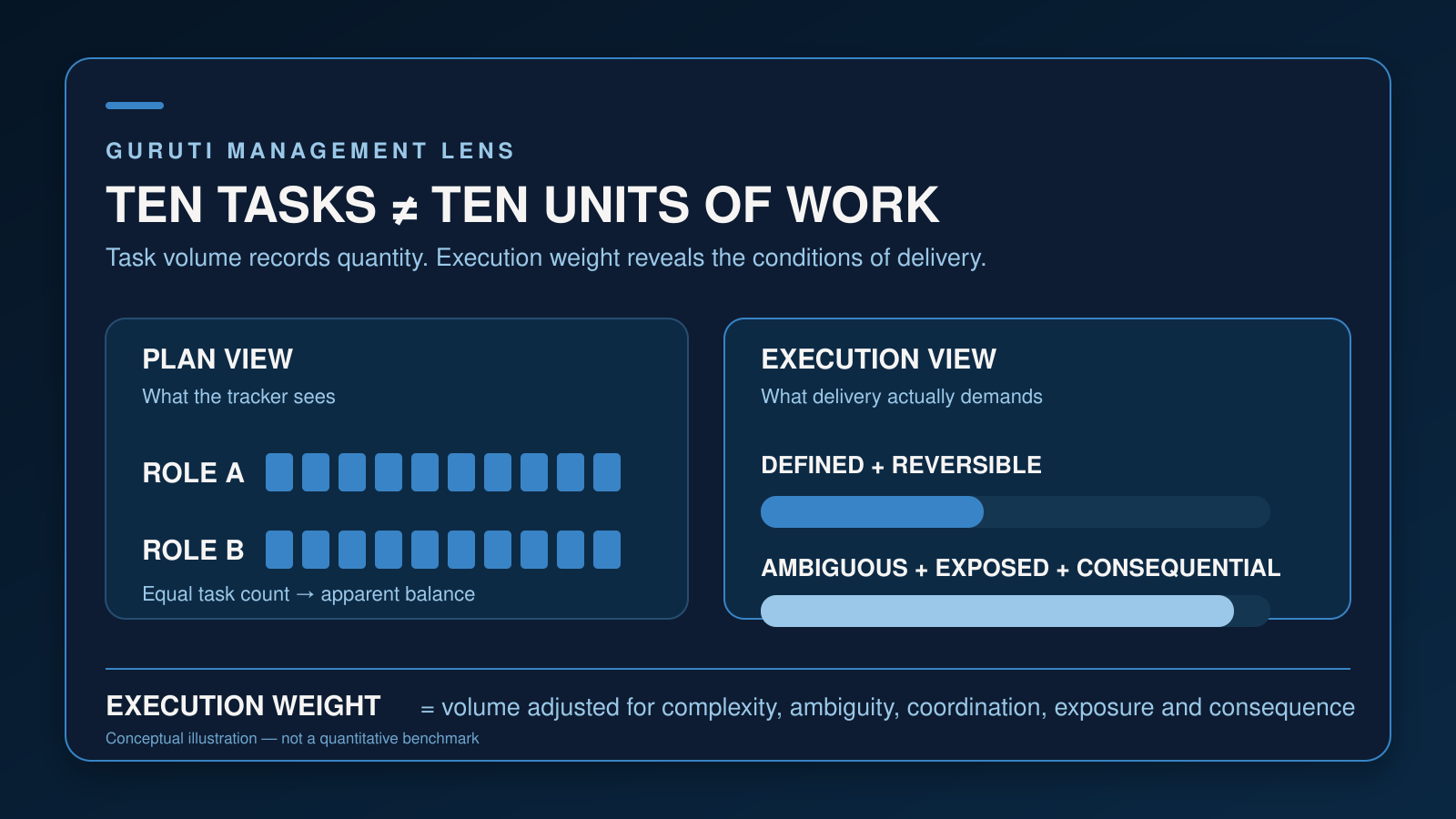
A transformation plan may assign ten tasks to a solution architect and ten to a functional lead. The workload appears balanced. The dashboard is green. The resource plan looks defensible.
But one set of tasks may be performed privately, with stable inputs, specialist tools and time to investigate, test and revise. The other may require a person to enter a live workshop with incomplete information, reconcile conflicting operational accounts, protect strategic intent, interpret system constraints and help senior stakeholders make a consequential decision before the meeting ends.
Both forms of work are essential. They are not equivalent units of effort.
This is where task-based planning becomes misleading. It measures visible activity while flattening the conditions under which the activity must be performed. It counts the workshop but not the preparation, interpretation, negotiation and recovery inside it. It records the requirement but not the ambiguity absorbed to make that requirement coherent. It sees the configured workflow but not the operating decisions that made configuration possible.
The result is a recurring governance failure: strategic-functional work is underweighted precisely because its output is clarity rather than configuration.
The task-count fallacy
Task counts are useful for tracking volume. They become dangerous when treated as a proxy for capacity.
A task is only a label. It says little about the amount of judgment required, the stability of the information available, the number of stakeholders involved, the consequences of a premature answer or the ease with which the output can be corrected later.
Consider two items on a transformation plan:
- Configure an approved approval rule in the target system.
- Define the approval rule for a multi-country operating model.
The first may be technically complex. The second may require finance, operations, compliance and technology to agree where decision rights sit, which exceptions are legitimate, what evidence is required and how local practices will be governed. Until that work is complete, there is no stable rule to configure.
Counting both as one task creates the appearance of equivalence while hiding their different execution weight.
This does not mean functional work is harder or more valuable than technical work. Technical teams carry their own deep complexity: architecture, security, integration, data integrity, performance, maintainability and the consequences of design choices that may persist for years. The point is narrower and more useful: complexity manifests differently across roles, and conventional project metrics do not capture those differences equally.
When leaders allocate capacity using task volume alone, they often overload the people who carry ambiguity, cross-functional coordination and live decision support. That overload remains invisible until decisions slow down, workshops become repetitive, requirements move, or technical teams receive inputs that are incomplete, contradictory or late.
What the functional task contains
In a transformation program, strategic-functional work is often described with deceptively simple verbs:
- explore;
- define;
- align;
- validate;
- standardize;
- adapt;
- approve.
Each verb can conceal several kinds of work at once.
To “define” a future process, for example, someone may need to understand how the current operation really works rather than how it is documented; separate legitimate variation from historical habit; identify dependencies across teams and systems; surface regulatory or commercial constraints; decide which exceptions should survive; translate the result into requirements; and explain the implications to people with different priorities and vocabularies.
The final process map may look simple because the complexity has already been resolved.
This is the intangibility discount: transformation programs tend to undervalue work that removes uncertainty because its output is clarity rather than a visible technical artifact.
A configured object can be counted. An integration can be demonstrated. A defect can be logged. But a contradiction resolved before configuration begins leaves no equivalent trace. Its value is expressed through problems that do not occur: less rework, fewer escalations, cleaner data, more coherent adoption and decisions that remain stable after the workshop.
By the time configuration looks straightforward, someone has already absorbed the ambiguity.
The functional exposure gap
The workload is not only in what must be resolved. It is also in the conditions under which resolution takes place.
Many strategic-functional tasks are performed in live environments: discovery sessions, design workshops, steering committees, operational validations and executive reviews. The person responsible is rarely presenting a fully closed answer. They may be interpreting new information, challenging assumptions and preserving alignment while the work itself is still being completed.
This creates the functional exposure gap: the unmeasured difference between performing a task and performing it while its meaning, assumptions and consequences are being interpreted and judged in real time.
Live exposure can combine several demands in the same window:
- analysis of incomplete information;
- facilitation across competing interests;
- translation between operational and technical language;
- explanation of uncertainty;
- protection of strategic intent;
- immediate decision support;
- professional judgment under scrutiny.
This is not an argument that every meeting is valuable. Many meetings are poorly designed, over-attended or unnecessary. Exposure only adds legitimate execution weight when the session is carrying real ambiguity, coordination or consequence.
It is also not a claim that scrutiny itself is inherently harmful. Effective challenge improves decisions. But challenge works only when people can surface uncertainty, ask for missing information and test assumptions without being penalized for doing so. Amy Edmondson's research on team psychological safety established a relationship between a shared belief that interpersonal risk-taking is safe and team learning behavior. In transformation terms, a room that suppresses doubt may look decisive while quietly producing weaker requirements and more expensive downstream correction.
The functional task is not only performed. It is interpreted, negotiated, defended and often judged while it is still being completed.
The translation burden between strategy and systems
“Requirements gathering” is too weak a description for much of this work. It suggests that requirements already exist in a stable form and simply need to be collected.
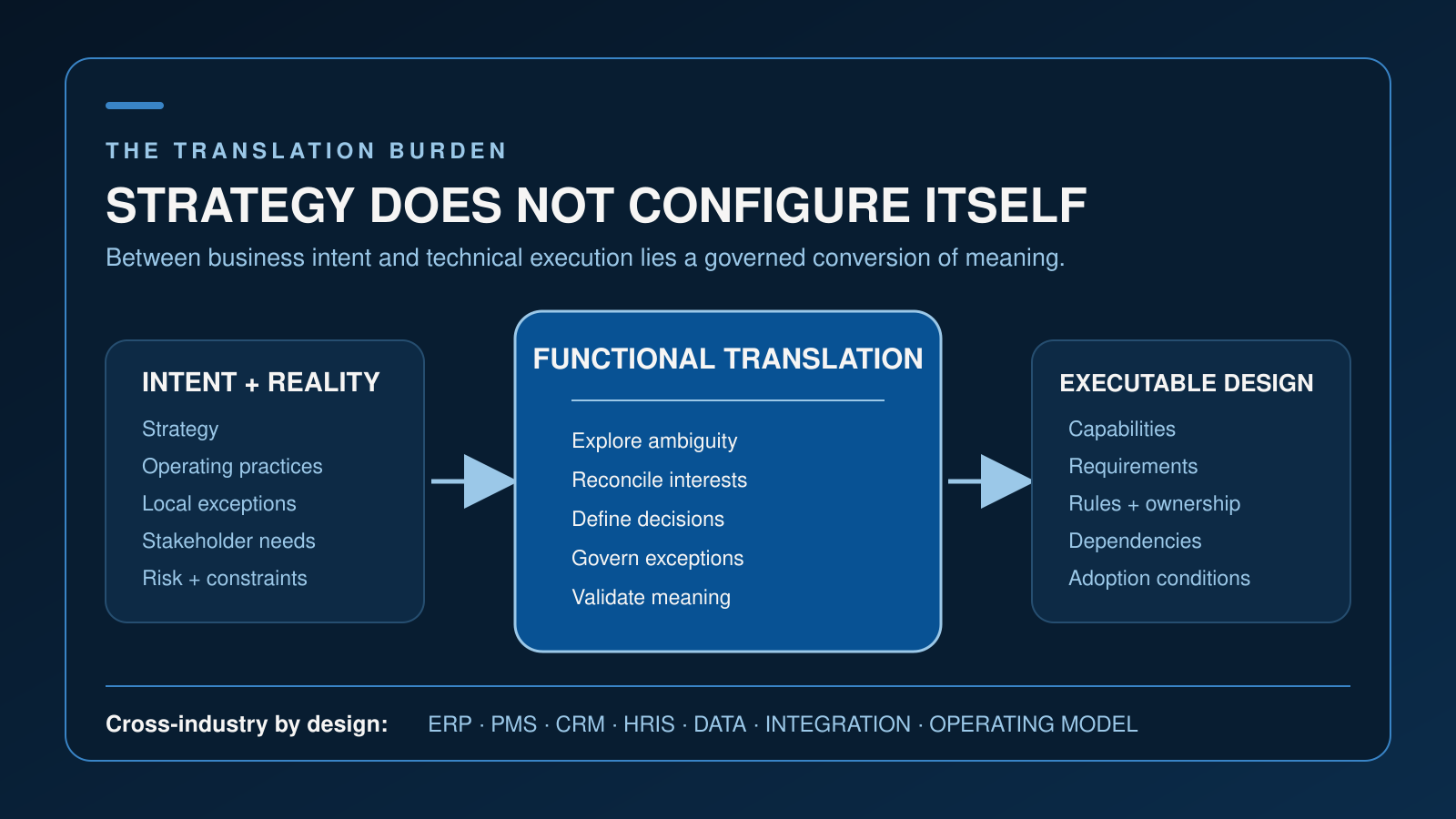
In reality, organizations often begin with intentions, pain points, local practices, exceptions, policies, incentives and conflicting accounts of how work should operate. These are not yet executable specifications. They must be examined, reconciled and converted into decisions that a technical team can implement without losing the original business meaning.
That conversion is the translation burden.
It turns:
| From | Into |
|---|---|
| Strategic intent | Prioritized capabilities and decision criteria |
| Operational reality | Process and system requirements |
| Local practices and exceptions | Governed rules and justified variants |
| Stakeholder conflict | Explicit decisions and ownership |
| Fragmented knowledge | A coherent target design |
| Risk and ambiguity | Sequenced actions, controls and dependencies |
| Desired outcomes | Executable configuration and adoption conditions |
Translation is not transcription. It requires judgment and synthesis across professional languages.
The requirements-engineering discipline treats this as a lifecycle of elicitation, analysis, specification, validation and management, not a clerical transfer of requests. Empirical research across companies and countries has also documented recurring problems such as incomplete requirements, communication flaws and moving targets. These are not abstract documentation defects. They are signs that the organization has not fully converted operating intent into a stable basis for delivery.
If nobody explicitly owns this burden, or if the role exists but has insufficient capacity, technical teams receive unstable inputs. The later symptoms appear technical: reconfiguration, customization, interface defects, data corrections or adoption resistance. Their origin may be unresolved business ambiguity.
Strategy does not configure itself.
Interruption is part of the workload
Strategic-functional roles often sit at the intersection of several workstreams. They move between executive priorities, process design, vendor questions, operational exceptions, data issues, change impacts and urgent escalations.
That position creates value because it connects the program. It also creates a workload that task counts rarely register.
Research on task switching has shown that attention can remain attached to a previous task after a switch, reducing performance on the next task. Experimental work on interrupted office tasks has likewise found that people may compensate by working faster while experiencing greater workload, stress, frustration, time pressure and effort.
The executive implication is not that all interruptions can be removed. Transformation work will always contain escalation and discovery. The implication is that a calendar fragmented by workshops and unscheduled decisions does not leave the remaining gaps as fully productive capacity.
A one-hour steering meeting may consume more than one hour of execution weight. It may require preparation across several sources, live synthesis under scrutiny, documentation of decisions, follow-up with affected teams and cognitive recovery before deep work can resume.
Plans that reserve only the visible hour understate the real demand.
The visibility paradox
Good strategic-functional work often makes itself disappear.
When ambiguity is resolved early, the requirement looks obvious. When stakeholders are aligned before build, configuration appears uncomplicated. When exceptions are governed, the target process looks clean. When dependencies are surfaced in advance, the delivery sequence appears natural.
This creates the visibility paradox: the better upstream clarification is performed, the simpler downstream execution appears, and the less visible the absorbed complexity becomes.
Technical complexity leaves evidence in architectures, code, interfaces, tickets, test results and system behavior. Functional complexity often leaves a decision, a definition and a room that can finally move forward.
This work disappears into the clarity it creates.
The paradox matters because governance tends to reward what remains visible. If sponsors see only the clean output, they may conclude that the upstream role was lightly loaded or could absorb more. The program then concentrates ambiguity and exposure in a small number of people until those people become bottlenecks, decision quality falls or the work becomes dependent on unsustainable individual effort.
From task volume to execution weight
Transformation leaders need a better planning lens. Not a universal formula, and not a new layer of bureaucracy. A practical adjustment to the way work is sized and governed.
At Guruti, we frame it this way:
Execution weight is task volume adjusted for complexity, ambiguity, coordination, exposure and consequence.
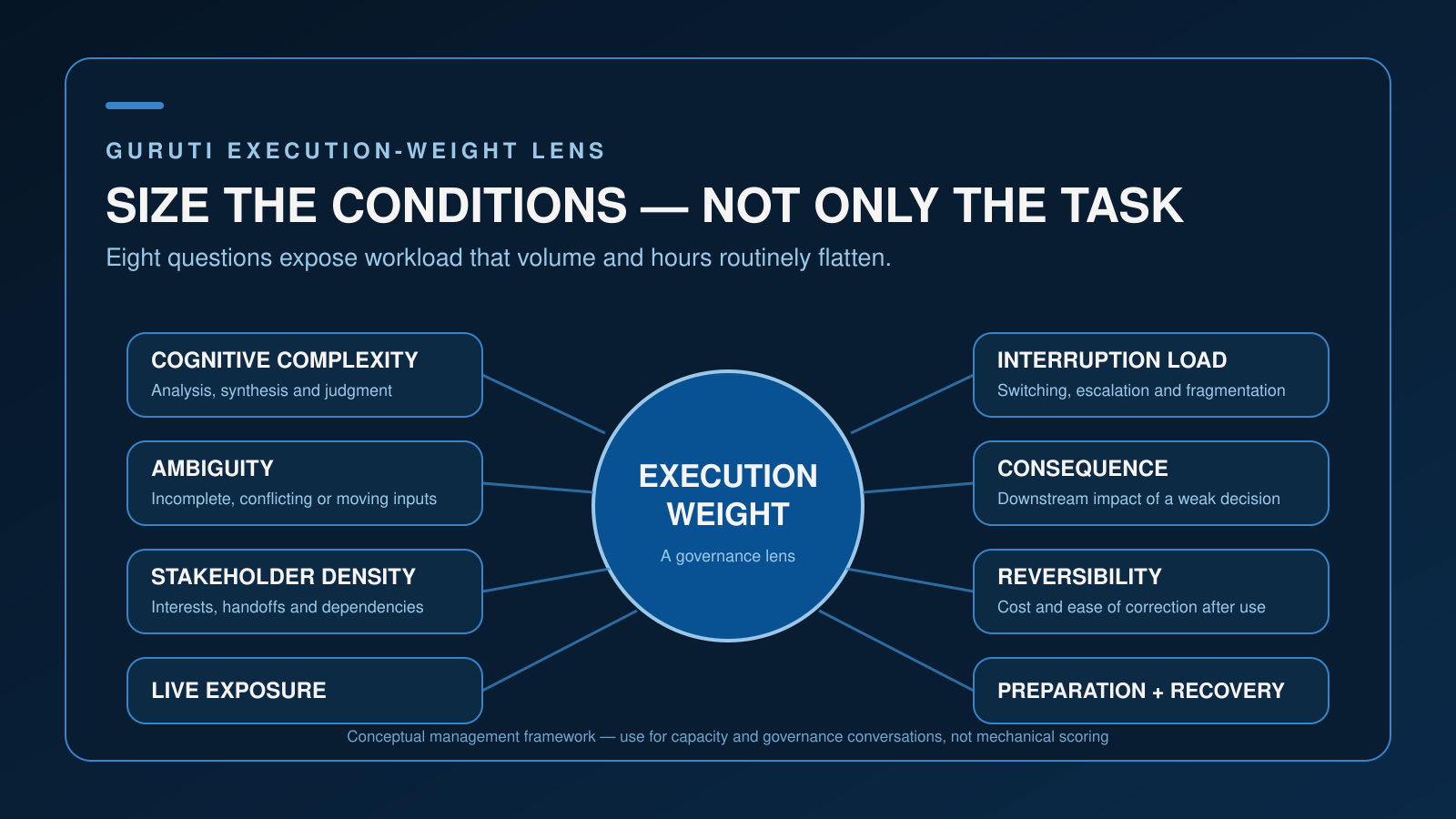
Interruption, reversibility, preparation and recovery may also materially affect the load.
This is a management framework, not a scientifically validated equation. Its purpose is to improve questions and decisions before a deceptively precise task count produces a false resource plan.
| Dimension | Governance question |
|---|---|
| Cognitive complexity | How much analysis, synthesis and judgment does the task require? |
| Ambiguity | How incomplete, conflicting or unstable is the available information? |
| Stakeholder density | How many parties, interests, handoffs and dependencies must be reconciled? |
| Live exposure | Must the work be completed or defended in real time under scrutiny? |
| Interruption load | How fragmented is the work by context switching, escalation and unscheduled input? |
| Consequence | What downstream impact can an incomplete or premature answer create? |
| Reversibility | How easily can the decision or output be corrected after first use? |
| Preparation and recovery | What work is required before and after the visible event? |
The model is deliberately qualitative. The goal is not to assign theatrical scores to every task. It is to identify work that requires different capacity protection, sequencing or role design.
What this changes in practice
1. Capacity plans distinguish volume from weight
Do not ask only how many tasks a person owns. Ask which tasks concentrate ambiguity, stakeholders, live exposure and consequence. Ten low-ambiguity actions may fit alongside one another; ten decision-intensive workshops may not.
2. Workshops are planned as delivery events
High-stakes workshops need explicit preparation and follow-through capacity. The visible meeting is only the center of the work, not its complete duration. Define the decision required, the evidence needed, who owns synthesis and what must happen after the room closes.
3. Translation ownership is explicit
Name the role that converts operating intent into executable design. Give it authority to surface contradictions, demand decisions and protect coherence across workstreams. Do not leave translation as an informal responsibility between business and technology.
4. Decision readiness becomes a measurable control
Track more than task completion. Ask whether assumptions are explicit, stakeholders are aligned, exceptions are governed, dependencies are visible and the decision is stable enough to build upon.
5. Functional and technical capacity are designed together
Do not protect one side by diminishing the other. Technical teams need stable inputs and access to operating context. Functional teams need early access to system constraints and architectural consequences. The most effective model reduces translation loss in both directions.
6. Sponsors protect the conditions for truth
Executives should expect challenge, uncertainty and incomplete information during design. If every workshop must perform certainty, weak assumptions will survive longer. Psychological safety is not softness; in this context, it is a condition for exposing delivery risk before it becomes system behavior.
Four moments where the gap becomes visible
In an ERP program, the difference appears when a “simple” approval workflow depends on unresolved decision rights across entities.
In a hotel technology transformation, it appears when mapping PMS, CRS, distribution and payment flows requires teams to reconcile commercial policy, guest experience, operational exceptions and system ownership before an integration can be designed.
In an M&A integration, it appears when “standardize the process” means deciding which legacy practices encode genuine business requirements and which merely reproduce history.
In a steering committee, it appears when one agenda item asks for a decision but the person supporting it must simultaneously explain uncertainty, compare trade-offs, anticipate downstream effects and maintain alignment across leaders who entered the room with different assumptions.
The task label is small. The execution weight is not.
An executive diagnostic
Before approving the next transformation capacity plan, ask:
- Which roles are carrying the greatest concentration of unresolved ambiguity?
- Where does cross-functional knowledge have to be translated into executable design?
- Which tasks require credible answers live, with limited opportunity for later revision?
- Have we included preparation, documentation, follow-through and recovery around decision-intensive events?
- Are key people fragmented across too many workstreams to sustain deep analysis?
- Which decisions have high consequence and low reversibility?
- Can teams safely expose missing information and challenge weak assumptions before build begins?
- Are we mistaking a clean downstream output for low upstream effort?
If these questions are absent, the program may be measuring activity precisely while understanding workload poorly.
Govern the weight of execution
Transformation does not fail because every task was difficult. It fails when the difficult work was misidentified, under-resourced or performed under conditions that weakened the decisions on which delivery depended.
Task counts will remain useful. Hours will remain necessary. Deliverables will remain visible. But none of them, alone, reveals the real weight of work that turns strategy into operating choices and operating choices into systems.
Mature governance recognizes the interdependence: strategic-functional work creates the clarity that technical work makes real; technical work exposes constraints that improve strategic-functional decisions. Both deserve capacity models that reflect how their complexity actually appears.
The objective is not equal recognition. It is better execution.
Because between strategy and systems lies a substantial translation burden. If it is not recognized, sized and governed, the organization configures technology on incomplete decisions.
Strategy does not configure itself.
If your transformation plan is balanced on paper but repeatedly constrained by slow decisions, unstable requirements or overloaded integrator roles, Guruti can help redesign the governance between strategy, operations and systems.
Explore Fractional CxO & Transformation PMO and Transformation Strategy & Operating Models, or book a confidential working session to identify where execution weight is being missed.
Evidence base and editorial boundaries
The five named concepts (Task-Count Fallacy, Functional Exposure Gap, Intangibility Discount, Translation Burden and Visibility Paradox) and the execution-weight lens are Guruti management framings. They are proposed as practical governance tools, not validated scientific constructs or a universal quantitative model.
External evidence supports specific mechanisms discussed in the article:
- Sophie Leroy, “Why Is It So Hard to Do My Work? The Challenge of Attention Residue When Switching Between Work Tasks,” Organizational Behavior and Human Decision Processes 109, no. 2 (2009): 168–181. DOI: https://doi.org/10.1016/j.obhdp.2009.04.002
- Gloria Mark, Daniela Gudith and Ulrich Klocke, “The Cost of Interrupted Work: More Speed and Stress,” CHI 2008 Proceedings (2008): 107–110. DOI: https://doi.org/10.1145/1357054.1357072
- Amy C. Edmondson, “Psychological Safety and Learning Behavior in Work Teams,” Administrative Science Quarterly 44, no. 2 (1999): 350–383. DOI: https://doi.org/10.2307/2666999
- ISO/IEC/IEEE 29148:2018, Systems and software engineering — Life cycle processes — Requirements engineering. Official overview: https://www.iso.org/obp/ui/#iso:std:iso-iec-ieee:29148:ed-2:v1:en
- Daniel Méndez Fernández et al., “Naming the Pain in Requirements Engineering: Contemporary Problems, Causes, and Effects in Practice,” Empirical Software Engineering 22 (2017): 2298–2338. DOI: https://doi.org/10.1007/s10664-016-9451-7
No numerical claim from these sources has been imported into the article. Their findings have been paraphrased conservatively and only where they illuminate the relevant mechanism.