A company may plan a three-year transformation with a three-year technology roadmap and a one-year talent mindset.
The systems architecture is mapped. Budgets are phased. Milestones are governed. RAID logs are maintained. Workstreams are staffed against projected demand. Steering committees review delivery confidence, dependencies and spend.
Yet one of the program's most valuable assets is often treated as if it remained static: the people who have been carrying the transformation since its earliest and most ambiguous stage.
They do not remain static.
By Month 12, the strongest contributors understand far more than their formal role suggests. They know why a design decision was made, which stakeholder concern sits behind a requirement, where a workaround is temporary, which dependency is politically sensitive and what happened the last time a similar issue was escalated.
At precisely this point, the program may be preparing to scale, and the individual may be preparing to move.
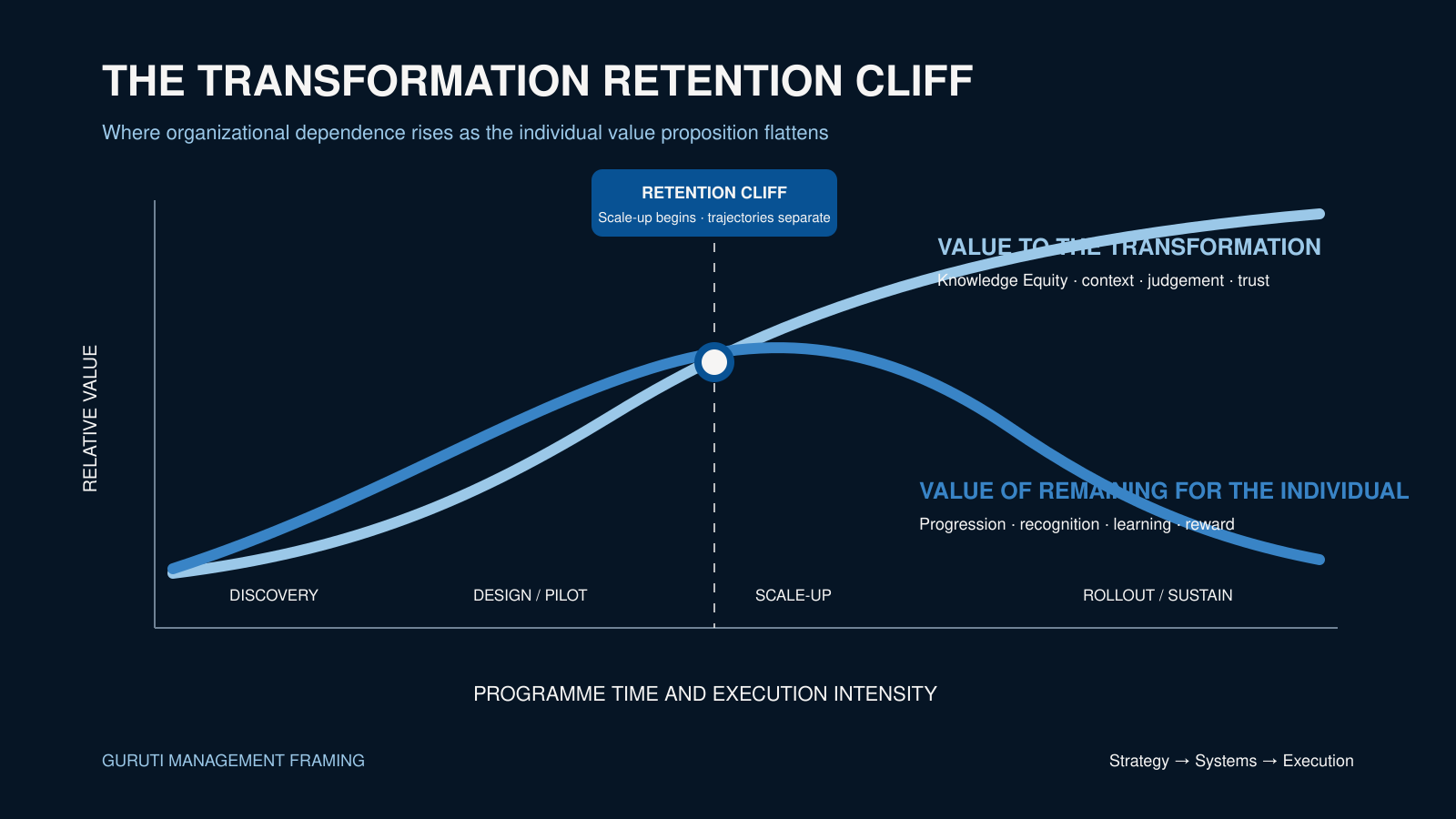
The resource becomes more valuable to the transformation at exactly the same time the transformation can become less valuable to the resource.
That is the Transformation Retention Cliff.
The contradiction at the heart of large programs
Most large transformations are designed around organizational demand. Leaders ask how many resources will be required, which skills are needed, when each workstream must mobilize and whether delivery capacity matches the roadmap.
Those are necessary questions. But they frequently describe people as units of capacity rather than assets whose value changes over time.
The resource plan may show “one business analyst,” “two deployment leads” or “one integration manager” for several consecutive phases. The spreadsheet implies continuity of quantity. It says little about continuity of knowledge.
That distinction matters because the work changes. Early contributors often move through discovery, operating-model definition, design, build, testing and readiness. They absorb decisions and exceptions that no job description can capture completely. As the program progresses, their value becomes increasingly specific to that transformation.
At the same time, their personal career equation changes. The next wave may offer more sites, more integrations, more pressure and more accountability, but the same title, the same package and limited visibility of what comes after delivery.
From the corporate perspective, continuity looks rational. From the employee perspective, a new program can look like progression.
Current workforce evidence reinforces the importance of that tension. LinkedIn reports that companies with high internal mobility show 53% longer employee tenure than companies with low internal mobility; earlier LinkedIn analysis found employees making internal moves were 40% more likely to remain with their company for at least three years. These figures are cross-company associations, not proof that mobility alone causes retention. But they support a practical point: visible movement and career opportunity inside the organization can change the value proposition of staying.
A Day 1 resource is not a Month 12 resource
On Day 1, a capable professional arrives with transferable expertise: project management, process analysis, technology knowledge, operations experience or change leadership.
By Month 12, that professional may hold an additional layer of value:
- the history behind key design choices;
- an understanding of formal and informal stakeholder influence;
- knowledge of exceptions that never reached the process map;
- awareness of dependencies across teams, vendors and geographies;
- pattern recognition from earlier defects and failed approaches;
- trust accumulated with operational teams;
- judgement about when standard governance is sufficient and when escalation is necessary.
This is not simply experience. It is experience made specific to the program.
Research on organizational turnover supports the distinction. A 2023 study in the Journal of Knowledge Management found that member turnover can produce organizational knowledge loss and trigger compensating knowledge acquisition. In practice, that means the organization may need to buy, rebuild or relearn capability after it has already financed the original learning.
Headcount can be replaced. Context cannot be replaced at the same speed.
Knowledge Equity: the value accumulated inside the program
Guruti uses Knowledge Equity to describe the accumulated value embedded in people through context, decisions, dependencies, stakeholder relationships, exceptions, workarounds, operational memory and transformation-specific execution understanding.
The term is intentionally a Guruti management framing, not a claim of a universally established accounting or academic category.
Knowledge Equity behaves differently from documented intellectual property. Some of it can be codified in process maps, decisions, runbooks, configuration records and lessons learned. Some remains tacit: the judgement that connects those records to reality.
It also compounds. A deployment lead who has supported several waves does not merely know three times as many facts. That person begins to see recurring failure patterns, distinguish local resistance from design defects and anticipate the consequences of decisions across functions.
The program has invested in this equity through salary, external support, workshops, testing, incidents, travel, leadership attention and the opportunity cost of learning. Yet many governance models do not measure where that equity is concentrated or how exposed it is.
Risk registers track vendors, integrations, budgets and dates. They should also track critical knowledge concentration.
The Transformation Retention Cliff
The cliff forms when two trajectories cross.
The first is organizational dependence. It rises as a contributor accumulates program-specific knowledge and becomes central to decisions, relationships or delivery confidence.
The second is the individual's perceived value of remaining. It may flatten when responsibilities expand without corresponding progression, recognition, compensation, decision rights or future opportunity.
Early in a program, the work itself can be developmental. There is ambiguity to solve, architecture to shape and visibility to earn. Later, the same person may be asked to repeat deployment patterns at greater scale, absorb more operational pressure and train new colleagues, without seeing a meaningful next step.
The organization sees a trusted resource ready for the next wave.
The resource may see another year of carrying the same label through a heavier wave.
Broader labor-market data suggests that this question remains active. In the Federal Reserve Bank of New York's July 2026 labor-market survey, satisfaction with promotion opportunities remained close to the series low reached earlier that year, while nearly one-quarter of respondents had searched for a job in the previous four weeks. The data is US-specific and not limited to transformation professionals, but it illustrates the wider environment in which program leaders compete for continuity. This is precisely where deliberate Human Readiness, Change & Adoption work earns its place alongside delivery governance: readiness is not only about the organization adopting change, but about the people carrying it choosing to stay through it.
Why the next wave can feel like a penalty
Transformation programs often reward entry into the program more visibly than endurance within it.
New joiners may receive a new title, a market-adjusted offer or the excitement of a fresh mandate. The people who stabilized the first wave may receive more incidents, more stakeholders and the responsibility to onboard those new joiners.
This produces a dangerous message:
The better you become at carrying complexity, the more complexity you will receive.
That is not always avoidable. Experienced people should take on broader responsibility. The problem arises when expanded responsibility is not matched by a credible evolution in role, authority, recognition, reward or future options.
The issue is therefore not a simplistic demand to promote everyone annually. It is the absence of an explicit progression logic.
The 2025 LinkedIn Workplace Learning Report describes career progress as a central motivation for learning and frames internal mobility as a mechanism that can align employee growth with organizational adaptability. LinkedIn's 2026 Talent Velocity research extends this logic by emphasizing shared workforce data, role clarity, skills architecture and career pathways as foundations for faster internal movement.
For a transformation program, the implication is direct: if leaders want people to remain through multiple phases, the program must offer a credible developmental journey inside the work.
Why losing these people is so expensive
When an experienced contributor leaves, the visible gap is capacity. The deeper loss is continuity.
Replacement costs extend beyond recruitment fees or contractor rates. They include:
- onboarding and shadowing time;
- reduced productivity while the replacement builds context;
- time taken from remaining experts to explain prior decisions;
- errors caused by incomplete historical understanding;
- delayed decisions and repeated escalations;
- rediscovery of dependencies and workarounds;
- damaged stakeholder confidence;
- greater reliance on the few knowledgeable people who remain.
The final effect is often circular. A departure increases the burden on remaining critical contributors, which can make further departures more likely.
This is why the economics of turnover should be evaluated at program level rather than only through an HR replacement-cost formula.
When critical knowledge walks out, the organization may end up paying twice for learning it already financed once.
The cost is particularly high during scale-up. Pilot phases produce learning; rollout phases consume it. Losing critical people between those phases weakens the conversion of learning into repeatable execution.
Why documentation alone is not enough
Documentation is indispensable. Without it, turnover risk becomes negligence.
But documentation has limits.
A decision log may record what was approved. It may not capture every concern that shaped the decision. A process map can describe the standard path. It rarely captures how experienced people recognize an emerging exception. A stakeholder map lists roles. It does not transfer trust.
Information can be stored. Judgement must also be developed.
That does not make documentation ineffective. It means continuity requires multiple mechanisms:
- controlled decisions and rationale;
- current process and configuration records;
- structured shadowing;
- paired ownership of critical domains;
- communities of practice;
- deliberate rotation;
- succession candidates with real exposure;
- overlap at phase transitions.
The objective is not to make every person irreplaceable. It is to prevent the program from discovering, too late, that one person already was.
From resource planning to Retention Architecture
Traditional resource planning asks:
- How many people do we need?
- Which skills are required?
- When must they join?
- How much will they cost?
Retention Architecture adds:
- Which contributors will become significantly more valuable as context accumulates?
- At which milestones will their responsibilities change?
- What progression can occur inside the program?
- How will recognition and incentives reflect increasing program value?
- Where is knowledge dangerously concentrated?
- Who can step into each critical domain?
- What future operating role could retain program knowledge after deployment?
Guruti defines Retention Architecture as the deliberate design of progression, recognition, incentives, internal mobility, milestone-based role evolution and continuity protection for critical transformation resources. This is inseparable from good Transformation Strategy & Operating Models work: an operating model that defines decision rights and process ownership but ignores who carries that knowledge is only half designed.
It is not a promise that no one will leave. Nor is it a retention bonus applied indiscriminately.
It is a design discipline that treats people continuity as part of the transformation operating model.
Mercer's 2026 Global Talent Trends research, drawing on nearly 12,000 executives, HR leaders, employees and investors across 16 geographies and industries, emphasizes the need to redesign talent systems around adaptability, skills and sustainable performance. The specific choices will differ by organization, but the direction is relevant: workforce architecture cannot remain separate from business transformation architecture.
What leaders should design differently
1. Link role evolution to program milestones
Define how roles can expand after design, pilot, first deployment or scale-up. Do not wait for annual performance cycles to recognize a material change in program value.
2. Create mobility inside the transformation
Allow strong contributors to move from one wave, market or workstream into another role that represents development, not simply more of the same.
3. Review incentives before the heaviest phase
The logical moment for a retention or compensation review may be before scale-up, not after a resignation.
4. Recognize accumulated context explicitly
Make visible the value of decision history, stakeholder trust and exception knowledge. If governance only celebrates new deliverables, continuity work becomes invisible.
5. Map knowledge concentration
Identify domains where one person is the practical source of truth. Record the risk, establish paired ownership and test whether another person can operate without constant rescue.
6. Build succession through exposure
Naming a backup is not succession. Backups need access to decisions, stakeholders, incidents and real delivery responsibility, the same kind of structured capability transfer that underpins effective Executive Education & Capability Building.
7. Protect experienced people from becoming permanent shock absorbers
Do not solve every gap by routing it to the people who coped best last time. Distribute escalation load and remove structural causes.
8. Give the Strategic PMO visibility
A Strategic PMO should monitor more than allocation and utilization. It should track critical-knowledge holders, role tenure, succession readiness, workload concentration, internal mobility and retention risk at phase transitions, a natural extension of the governance a Fractional CxO & Transformation PMO is already accountable for.
Change fatigue makes this operational, not theoretical. SHRM characterizes change fatigue as a business risk associated with lower productivity, higher absence, reduced quality and delayed timelines. A program cannot protect execution confidence while ignoring the human concentration of pressure.
Executive diagnostic
Leaders should ask:
- Which people know why our most important transformation decisions were made?
- Where would delivery slow materially if one person left within the next 30 days?
- Which Day 1 contributors now carry Month 12 value without a corresponding role evolution?
- Does the next program wave offer those people development, or merely more pressure?
- Have we reviewed recognition, authority and incentives before entering scale-up?
- Can our named successors operate independently, or are they backups only on paper?
- Which critical relationships and exception-handling practices remain undocumented or unshared?
- Does the PMO monitor knowledge concentration and continuity risk alongside budget, scope and schedule?
- What future operating roles could retain transformation knowledge after deployment?
- Are we treating retention as an HR response, or designing it as part of the transformation operating model?
If several answers are unclear, the program may already be approaching its Retention Cliff.
Strategy → Systems → Execution requires continuity
Transformation is not delivered by a roadmap alone.
It is delivered by people who interpret the roadmap, resolve contradictions, preserve decision history, connect stakeholders and turn learning into repeatable execution.
Organizations do not need to prevent every departure. They need to understand which departures would destroy disproportionate value, and act before dependence and dissatisfaction intersect.
Resource planning ensures that roles appear on the plan.
Retention Architecture helps ensure that critical capability remains long enough to convert investment into operating reality.
Do not only plan resources. Plan their evolution.
Sources
- LinkedIn Talent Solutions. “New LinkedIn Data: How Internal Mobility Benefits Employers.” 24 June 2024.
- Galan, N., et al. “Knowledge loss induced by organizational member turnover.” Journal of Knowledge Management, 2023.
- Federal Reserve Bank of New York, Center for Microeconomic Data. “SCE Labor Market Survey.” July 2026 release.
- LinkedIn Learning. “2025 Workplace Learning Report.” 2025.
- LinkedIn Learning. “2026 Talent Velocity Advantage Report.” 2026.
- Mercer. “Global Talent Trends 2026.” 2026.
- Society for Human Resource Management. “How to Combat Change Fatigue in an Era of Constant Disruption.” 22 July 2025.
Transformation Retention Cliff, Knowledge Equity and Retention Architecture are Guruti management framings drawn from cross-functional transformation experience. The external research above supports the article's component arguments (internal mobility, career development, change fatigue and knowledge loss) without independently proving that every multi-year transformation follows the proposed pattern.
Is critical transformation knowledge becoming concentrated in too few people?
Guruti helps leadership teams and Strategic PMOs connect governance, operating-model design, human readiness and execution continuity. A focused conversation can identify where delivery dependence is rising, and what should be protected before the next program wave.
Book a Strategy Session Learn more about Fractional CxO & Transformation PMO