
A connected hotel is not a hotel with many integrations. It is a hotel where information reaches the right decision, in the right context, with clear ownership.
Hospitality technology portfolios have expanded around the guest journey and the operating model: PMS, CRS, booking engine, channel manager, RMS, CRM, payments, POS, housekeeping, maintenance, finance, HR, identity, business intelligence and many specialist applications.
The usual response is to draw lines between the boxes. Yet connectivity on a diagram does not guarantee operational coherence. Two systems can exchange data and still disagree about meaning, timing, authority or what should happen when the exchange fails.
The objective is not seamless technology in the abstract. It is reliable execution across the moments where hotel operations depend on shared information.
Stop designing the stack as a shopping list
A list of “essential hotel systems” can help describe the market, but it is a weak architecture. It starts with products rather than the capabilities and decisions the business must support.
A group operating full-service resorts across markets will not have the same integration priorities as an independent urban hotel. Brand standards, ownership structure, central services, distribution model, regulatory context, operating complexity and legacy constraints all change the target design.
Guruti's Transformation Strategy & Operating Models approach therefore starts with operating reality:
- which capabilities must be local, shared or centralized;
- which decisions require real-time information;
- where ownership and accountability sit;
- which variations create value and which create unnecessary complexity;
- and what the hotel must still be able to do when a system or interface is unavailable.
Design around operational decisions
Integration has purpose when it improves a decision or removes an avoidable manual handoff. Examples include:
- Can a reservation be sold, modified and fulfilled with consistent inventory, price, restrictions and guest commitments?
- Can the property recognize the guest appropriately without exposing data beyond a legitimate operational purpose?
- Can a payment be authorized, posted, reconciled and investigated across the systems that touch it?
- Can an out-of-order room update availability and trigger the correct operational response?
- Can finance explain revenue, tax, settlement and receivables without rebuilding the transaction manually?
- Can leadership see comparable performance without erasing meaningful local context?
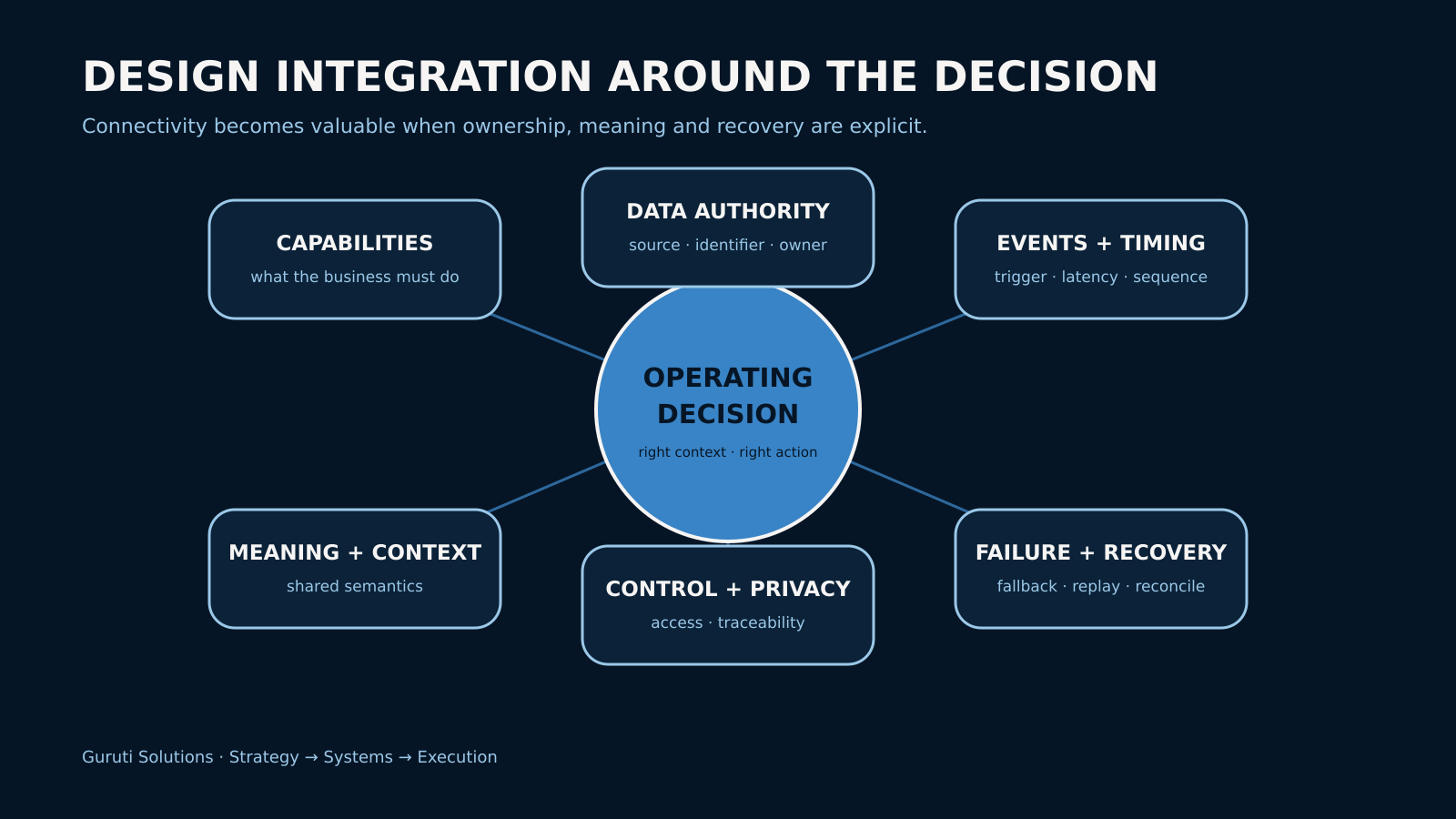
Each decision reveals the necessary systems, events, data, timing, controls and people. This is more useful than beginning with a goal to “integrate the PMS with everything.”
Define systems of record and systems of action
Connected environments become unstable when several applications can create or overwrite the same business fact without explicit authority.
For each critical data domain (guest profile, reservation, availability, rate, room status, product, payment, account, employee, asset), the architecture should define:
- the authoritative source;
- which systems may create, enrich, consume or correct it;
- the identifier used across boundaries;
- the acceptable timing and latency;
- the retention, access and privacy rules;
- and the reconciliation path when records diverge.
A system of record does not need to perform every action. A CRM may activate guest engagement while a PMS supports the operational stay, for example. The design must make that distinction intentional.
Treat integration as an operating contract
An interface is often documented through endpoints, fields and frequency. Operations also need a contract describing behavior.
For every material flow, define:
- Trigger. What business event starts the exchange?
- Payload and meaning. Which information moves, under which definitions?
- Owner. Who is accountable for source quality and end-to-end resolution?
- Timing. Must the response be immediate, near-real-time or batched?
- Control. How are duplicates, missing values, unauthorized changes and sequence errors detected?
- Exception path. Who acts when the integration does not complete?
- Recovery. Can events be replayed, reconciled or safely corrected?
This converts integration from invisible technical plumbing into a governed operational dependency.
APIs create access; architecture creates coherence
Modern hospitality platforms increasingly expose open APIs and business events. Oracle's Hospitality Integration Platform, for example, provides access to OPERA Cloud capabilities across reservations, profiles, front desk, housekeeping, inventory, rates and business events. Oracle also publishes REST API specifications for implementation use.
This access can accelerate integration, but an API catalogue does not decide which platform owns a guest profile, how a failed reservation update is recovered or whether a local customization should become a group standard.
The role of Enterprise Systems, Integration, Data & AI is to connect platform capability with data governance, security, operating ownership and measurable business outcomes.
Data must carry context, not only values
A room type code, market segment or package can be technically synchronized and operationally misunderstood. Meaning often depends on property, date, source, status, currency, tax treatment, membership, entitlement or business process.
Shared definitions and mapping governance are therefore essential. The architecture should make transformations visible: where values are converted, aggregated, enriched or rejected. Otherwise, teams discover semantic differences only after a guest, revenue or accounting exception has occurred.
Data quality is also reciprocal. Interfaces should not become pipelines that distribute poor source data faster. Validation must occur close to the point of creation, with ownership for resolving recurring causes.
Protect the guest across the ecosystem
A connected stack moves personal and payment-related information across more boundaries. Convenience does not remove the obligation to define purpose, access, retention, monitoring and accountability.
The NIST Privacy Framework provides a voluntary enterprise-risk approach to identifying and managing privacy risk. For a hotel ecosystem, the practical questions include:
- Does every receiving system need the full guest record?
- Can access be limited by role, property and purpose?
- How are consent, preference and retention rules propagated?
- Where are sensitive values tokenized or deliberately excluded?
- Can the organization trace who changed what and why?
- How are vendor access and integration credentials governed?
Privacy and security are architecture constraints from the beginning, not checks added after connectivity has been built.
Design for failure, not only the happy path
Hotels operate continuously. Interfaces, networks and vendor services do not achieve permanent perfection. Resilience therefore depends on controlled degradation.
For critical flows, leaders should know:
- what staff can continue doing during an outage;
- which transactions queue and which require manual control;
- how teams identify stale or partial information;
- how recovery avoids duplicate reservations, charges or profiles;
- who communicates with properties, central teams and vendors;
- and how reconciliation proves that the operation is complete again.
A resilient manual fallback is not evidence that integration is unnecessary. It is evidence that operating continuity has been designed.
Govern the ecosystem beyond implementation
Hotel technology stacks evolve through upgrades, acquisitions, new distribution channels, regulatory changes, property openings and vendor decisions. Integration is therefore a product and governance capability, not a one-time project.
Ongoing governance should maintain:
- a capability and system map;
- data ownership and interface catalogues;
- change impact and dependency assessment;
- service levels, monitoring and recurring exception review;
- security, privacy and vendor-access controls;
- technical debt and lifecycle decisions;
- and business measures showing whether integration improves execution.
The specialized hotel maintenance operating model illustrates the principle: CMMS, PMS, ERP, inventory and operational teams should connect only through explicit events, ownership and recovery paths.
A practical architecture sequence
- Map capabilities and operating decisions. Understand how the hotel creates value and where information affects execution.
- Establish current-state truth. Inventory systems, interfaces, manual handoffs, owners, data and failure points.
- Define the target operating model. Decide what is global, central, regional, local and vendor-owned.
- Assign data authority. Define systems of record, identifiers, semantics, access and reconciliation.
- Prioritize integration journeys. Sequence end-to-end flows by business risk and value, not by interface count.
- Build observability and recovery. Test exceptions, not only successful messages.
- Prepare users and support. Make new workflows, ownership and escalation paths operationally real.
- Govern continuous change. Review performance, debt, vendor roadmaps and emerging capabilities as one portfolio.
Integration is an operating capability
The future of hospitality will not be won by the property with the longest technology list. It will be shaped by organizations that can convert information into coordinated decisions across the guest journey and the enterprise.
Guruti's Hospitality Technology Transformation practice connects operational reality, platform architecture, data, deployment and human readiness. The aim is not theoretical seamlessness. It is an ecosystem that remains understandable, governable and useful when real hotel operations place it under pressure.
If your hotel or group is redesigning its technology stack, planning a PMS/CRS migration or resolving fragmented integrations, Book a Strategy Session.