
A hotel does not need another digital work-order inbox. It needs a maintenance operating model.
When maintenance is managed through calls, paper notes, messaging groups and individual memory, a CMMS can look like the obvious answer. Yet installing software does not automatically create control. If asset information is incomplete, priorities remain subjective and ownership is unclear, the new platform may simply reproduce the old disorder with better timestamps.
The strategic question is therefore not, “Which maintenance application should we buy?” It is, “How should the property identify risk, plan work, mobilize people, protect assets and learn from every intervention?”
A CMMS creates value when it turns maintenance activity into operational reliability, not when it merely converts paper into tickets.
Maintenance is part of the guest operating model
Maintenance is sometimes treated as a technical service behind the hotel operation. Guests experience it differently. They encounter room availability, temperature, water, lighting, lifts, pools, kitchens, spas and public areas as one service promise. A failure in any of these assets can quickly become an operational, safety, revenue or reputation issue.
This makes hotel maintenance a cross-functional capability. Engineering may execute much of the work, but front office, housekeeping, food and beverage, security, procurement, finance and management all create or consume maintenance information.
Guruti's Hospitality Technology Transformation perspective places CMMS/GMAO within that wider operating system: property operations, systems, data, people and governance must reinforce one another.
Start with assets, criticality and service consequences
A reliable maintenance model begins with an asset structure that reflects the real property. Equipment must be identifiable by location, type, dependency and service consequence. Otherwise, teams receive descriptions such as “air conditioning problem” without knowing which unit, component, warranty, history or operational dependency is involved.
Not every asset deserves the same strategy. Criticality should consider more than replacement cost:
- guest and employee safety;
- impact on sellable inventory or service continuity;
- regulatory and inspection requirements;
- dependency on other systems or spaces;
- availability of parts and specialist support;
- energy, water and sustainability implications;
- and the time and complexity required to recover.
ISO 55000:2024 frames asset management around lifecycle value and alignment with organizational objectives. Applied to hospitality, that means maintenance priorities should reflect how assets support safe, reliable and commercially usable operations, not simply how many requests have been opened.
Design the process before configuring the CMMS
The future workflow should be defined before fields, statuses and automations are configured. At minimum, the design must answer:
- Who can report an issue? Staff, guests through assisted channels, sensors or connected systems may all initiate demand.
- What information is mandatory? Location, asset, symptom, urgency, operational impact and supporting evidence should be proportionate to the request.
- Who validates and prioritizes? A noisy complaint is not always the highest operational risk, and a quiet defect is not always low priority.
- How is work assigned? Skills, shifts, access, parts, contractors and service windows affect execution.
- What closes the task? Completion should distinguish work performed, asset restored, quality checked and requester informed.
- What triggers escalation? Safety, repeat failure, unavailable rooms, SLA breach and business impact need explicit routes.
Without these decisions, configuration starts absorbing policy questions that leaders have not resolved. The project then mistakes system settings for operating-model design.
Move from reactive response to a balanced maintenance strategy
Reactive work will never disappear from a hotel. The objective is to prevent avoidable emergencies and make the unavoidable ones easier to manage.
A mature portfolio combines several approaches:
- corrective maintenance for faults that require restoration;
- preventive maintenance based on time, usage, regulation or manufacturer guidance;
- condition-based interventions where reliable readings or inspections justify action;
- statutory inspections and controls with traceable evidence;
- planned renewal where lifecycle, failure patterns and business priorities support replacement.
The CMMS should make this strategy executable through plans, frequencies, checklists, skills, calendars and evidence. It should not encourage teams to maximize preventive-task counts regardless of value.
Make mobile execution simpler than the workaround
Maintenance takes place in rooms, plant areas, kitchens, roofs, pools and public spaces, not at a desktop. Mobile execution is therefore an operating requirement, but the interface must respect frontline conditions.
Technicians need fast access to the correct asset, work history, instructions, safety information and parts. They must be able to record time, observations, materials, photos and follow-up needs without turning every intervention into an administrative exercise.
Adoption fails when the official workflow is slower than messaging a colleague or writing a note. The Human Readiness, Change & Adoption challenge is to design the process with users, define role expectations, train around real scenarios and reinforce data quality after launch.
Connect inventory, procurement and contractors
A work order can be assigned correctly and still remain blocked because a part is unavailable, a supplier must be approved or an external specialist lacks access. Maintenance performance therefore depends on information beyond the maintenance team.
The operating model should define:
- which spare parts are critical and where they are held;
- minimum and reorder rules proportionate to risk;
- how materials are reserved and consumed against work;
- how warranties, contracts and service levels are recorded;
- how external work is authorized, evidenced and evaluated;
- and how cost information reaches finance and asset decisions.
This is where CMMS, procurement, inventory and ERP boundaries must be explicit. Duplicate records and unclear systems of record create apparent integration while weakening control.
Integrate only where an operational decision requires it
A CMMS does not need every data field from every hotel system. It needs reliable events and reference data that support defined decisions.
Useful connections may include room or space status from the PMS, requests from housekeeping or guest-service channels, asset and cost data from ERP, inventory movements, identity and role data, building-management alerts and business-intelligence outputs.
Oracle's Hospitality Integration Platform, for example, exposes APIs covering housekeeping information, maintenance-related room status, inventory and business events. The broader lesson is vendor-independent: integration should begin with the event, owner, action and recovery path, not with a diagram of available interfaces.
The wider connected hotel technology stack must also define what happens when an interface is delayed, data conflicts or the receiving system is unavailable.
Turn maintenance data into management decisions
Dashboards become useful only after definitions and behaviors are stable. A low closure time can hide repeated temporary fixes. A high preventive-completion rate can hide low-value tasks. A small backlog can hide unreported work.
Leaders should combine activity, reliability and business measures:
- response and restoration time by criticality;
- repeat failures and reopened work;
- preventive work completed on time and its effectiveness;
- planned versus reactive workload;
- rooms or services affected and recovery time;
- parts availability and contractor performance;
- asset lifecycle, energy or water signals where relevant;
- data completeness and work reported outside the system.
ISO 41001 connects effective facility-management delivery with organizational objectives and stakeholder needs. That is a useful discipline: maintenance metrics should show whether the property is becoming more reliable, safe and operationally resilient, not merely busier.
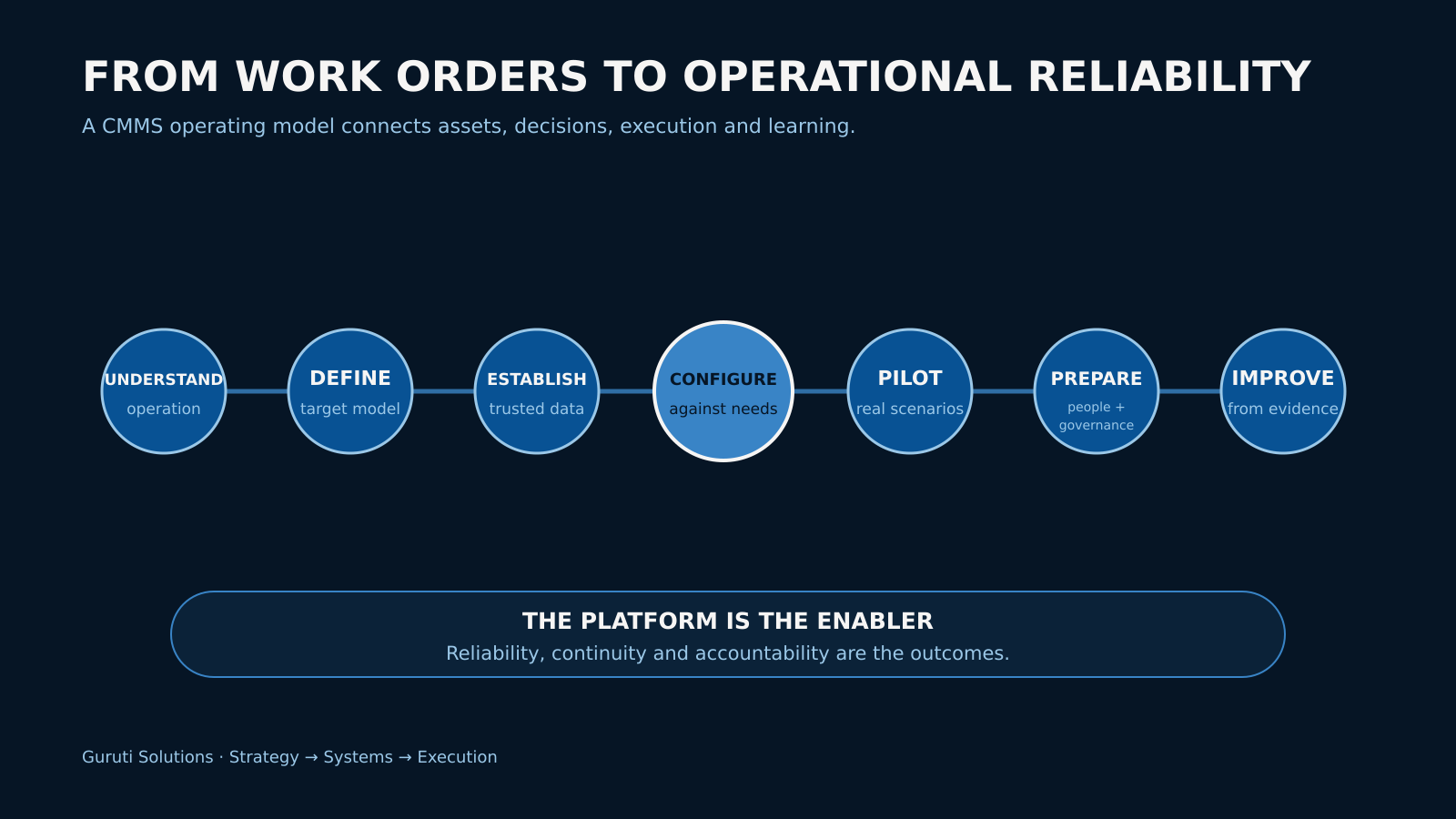
A practical CMMS transformation sequence
- Understand the operation. Map assets, failure demand, roles, workarounds, contracts and current data.
- Define the target model. Agree criticality, maintenance strategies, decision rights, workflows and measures.
- Establish trustworthy foundations. Clean the asset hierarchy, locations, parts, plans and ownership.
- Select and configure against requirements. Evaluate usability, mobility, integration, security, scalability and support.
- Pilot real operating scenarios. Test routine, urgent, contractor, parts-constrained and cross-department cases.
- Prepare people and governance. Train by role, establish support and make leaders accountable for adoption.
- Improve from evidence. Review failures, backlog, compliance, reliability and data quality as one operating rhythm.
The system is an enabler; reliability is the outcome
A CMMS can centralize work, strengthen traceability and make asset history visible. But the platform cannot decide what matters, resolve ownership or make poor data trustworthy by itself.
Guruti connects maintenance transformation to Enterprise Systems, Integration, Data & AI, operating design and frontline adoption. The objective is not a more sophisticated list of work orders. It is a property that can anticipate risk, coordinate execution and protect the guest and employee experience with better information.
If your hotel or group is assessing CMMS/GMAO, redesigning maintenance processes or connecting facilities management with PMS and ERP, Book a Strategy Session.