
Hospitality has traditionally scaled by adding physical capacity. XaaS asks a different question: what value could scale without adding another room?
The room remains essential. So do the property, the operation and the human moments that make hospitality distinctive. But the business surrounding them is changing. Cloud platforms, open interfaces, specialist partners, remote capabilities and digital relationships make it possible to separate access from ownership and service reach from physical footprint.
This is the strategic promise behind Everything-as-a-Service, or XaaS. Applied to hospitality, it does not mean turning every experience into a subscription. It means designing capabilities so they can be accessed, combined, measured and improved as services, inside the enterprise and across an ecosystem.
The XaaS opportunity is not to make hospitality less physical. It is to make value less constrained by what the organization must own itself.
What XaaS means in hospitality
XaaS developed from the logic of software and cloud services: organizations consume a capability when needed rather than buying and maintaining every component themselves. Deloitte Digital describes XaaS as a strategic business-model approach built on the evolution of Software-as-a-Service.
For a hotel group, this logic can appear in several layers:
- Technology as a service: cloud PMS, integration platforms, payments, analytics and cybersecurity capabilities.
- Operational capability as a service: centralized revenue management, finance operations, reservations support or specialist expertise shared across properties.
- Experience as a service: curated services that accompany the guest before, during and after the stay.
- Ecosystem access as a service: local, wellness, mobility, food or entertainment capabilities delivered through partners.
- Brand capability as a service: standards, operating knowledge, distribution or experience design extended through management, licensing or partnership models.
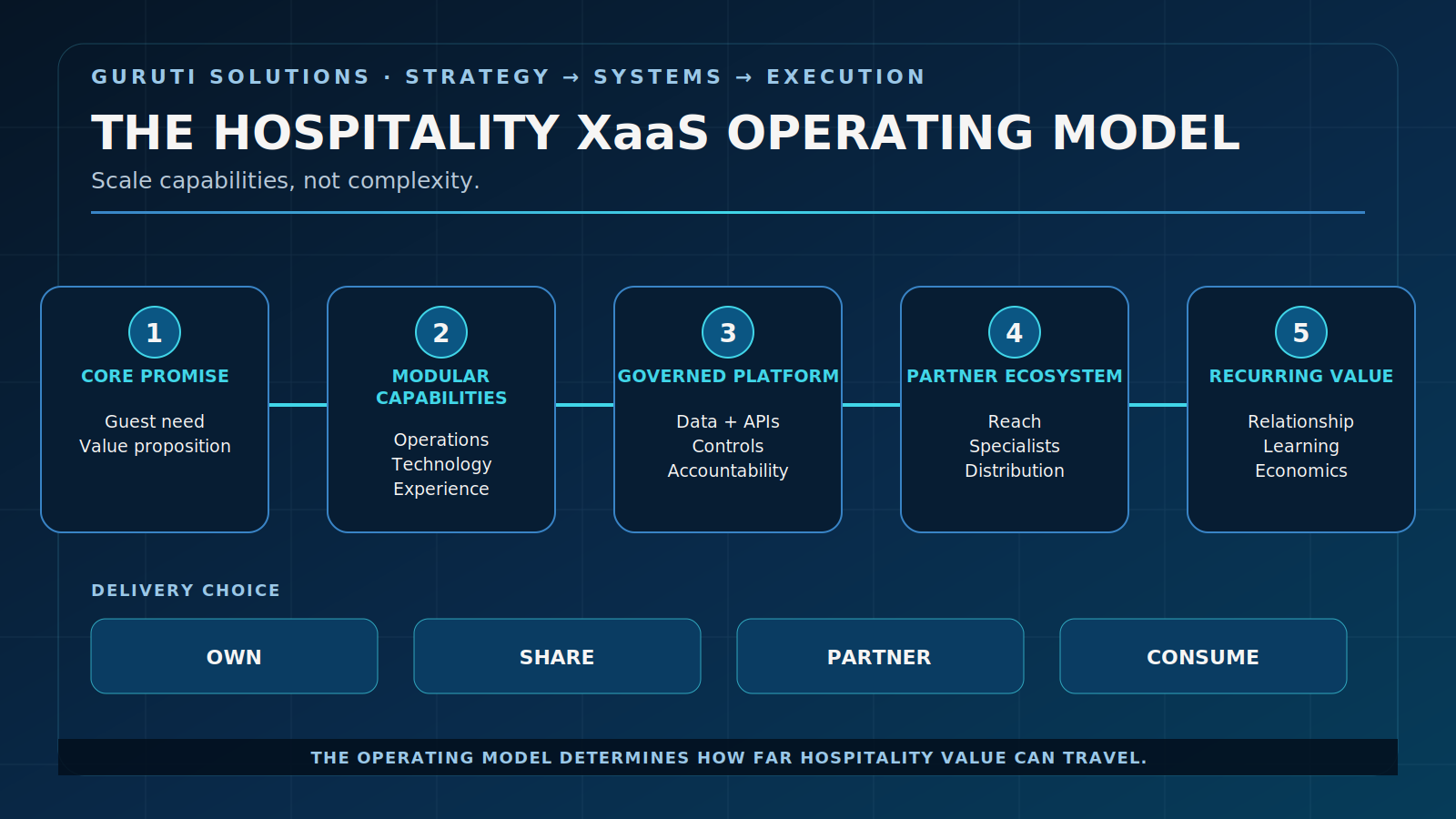
The common principle is modularity. A useful capability has a defined consumer, service promise, owner, interface, economics and performance standard.
XaaS is an operating model, not a procurement category
Moving a system to a recurring contract does not create an XaaS transformation. It changes how the organization pays for technology.
The strategic shift occurs when leaders redesign how value is assembled and delivered. That requires decisions about what should remain core, what can be shared, what can be sourced, where partners create advantage and how accountability works across organizational boundaries.
A credible XaaS model therefore begins within Transformation Strategy & Operating Models. Technology follows the service design, not the reverse.
Five tests for a hospitality capability
1. Is the consumer clear?
A service may support a guest, a property, a brand, a franchisee or an internal function. If the consumer is ambiguous, priorities and service levels will be ambiguous too.
2. Is the value proposition specific?
“Centralization” is not a value proposition. Faster rate decisions, consistent configuration, lower duplication or extended service coverage are. The intended benefit should be visible to the service consumer.
3. Can it operate through a repeatable interface?
A scalable service needs defined inputs, outputs, data, handoffs, exceptions and escalation routes. Without them, the model remains dependent on personal coordination.
4. Are the economics transparent?
Leaders need to understand consumption, unit cost, capacity, supplier dependency and the conditions under which the service creates more value than local ownership.
5. Can performance improve over time?
A service model should generate learning. Usage, outcomes, incidents and feedback should inform continuous improvement rather than remain trapped in separate contracts or properties.
The platform enables orchestration
Hospitality XaaS depends on a connected systems foundation. Oracle’s Hospitality Integration Platform illustrates the direction: open APIs expose reservation, profile, housekeeping, inventory, rate and other operational capabilities so applications can interact with the PMS ecosystem.
APIs alone do not produce an operating model. The enterprise still needs authoritative data, integration ownership, security, consent, service monitoring and clear responsibility when a partner-dependent journey fails.
This is where Enterprise Systems, Integration, Data & AI becomes central. The architectural question is not how many systems can connect. It is whether the right capabilities can cooperate reliably around a business decision or guest moment.
Growth beyond physical footprint
XaaS can decouple selected forms of growth from property expansion. A hospitality brand might extend expertise across a portfolio, distribute curated local services, operate shared capabilities for multiple properties or maintain a relevant relationship beyond checkout.
But possibility is not a business case. Each proposition must answer:
- which customer or property problem it solves;
- why the brand is credible in that role;
- how demand and willingness to pay will be tested;
- what operating capabilities and partners are required;
- how quality will be controlled;
- and whether the economics improve with scale.
Reaching more users is not the same as creating profitable value. The discipline lies in testing the service model before scaling the infrastructure around it.
From room-night economics to relationship economics
XaaS becomes more powerful when connected to the complete guest relationship. Guruti’s Lifetime Experience Value framing asks whether the organization can understand and improve value beyond an individual stay. XaaS asks how the necessary capabilities can be delivered flexibly across that lifecycle.
The relationship may include inspiration, booking, arrival, in-stay service, recovery, post-stay engagement and future demand. Not every stage needs another product. Each stage does need coherent ownership and the ability to activate useful context.
The risks leaders must design around
Service models transfer some responsibilities and create others. Common risks include:
- Fragmented accountability: every provider meets its contract while the end-to-end experience fails.
- Vendor dependency: critical capability becomes difficult to move, integrate or govern.
- Invisible cost growth: consumption rises without clear unit economics or value controls.
- Brand dilution: partner delivery does not meet the promise guests associate with the brand.
- Data and consent gaps: information moves across parties without sufficient purpose, quality or governance.
- Operational overload: frontline teams coordinate complexity that the service architecture was meant to remove.
A sound Hospitality Technology Transformation therefore governs ecosystem risk, operational readiness and value realization together.
A practical path to a hospitality XaaS model
- Start with a value constraint. Identify a guest, property or portfolio need that the current model cannot address efficiently.
- Define the capability. Specify consumer, outcome, boundaries, owner and service promise.
- Choose the sourcing logic. Decide what to own, share, partner, license or consume.
- Design the operating interface. Map data, handoffs, service levels, exceptions and accountability.
- Model the economics. Test unit cost, demand, capacity, margin, dependency and scaling assumptions.
- Pilot the complete service. Validate operations and experience, not only technical connectivity.
- Scale with governance. Monitor value, quality, resilience, partner performance and learning.
Executive diagnostic
- Which capabilities genuinely differentiate us and which merely need to be reliable?
- Where does ownership add value, and where does it add fixed complexity?
- Which portfolio capabilities could be shared without weakening local operations?
- Can our platforms expose and consume services through governed interfaces?
- Who owns the end-to-end experience when several partners contribute?
- Do we understand unit economics and consumption risk?
- Can frontline teams operate the model without becoming manual integrators?
- How will we protect guest trust, data and brand standards?
- What evidence would justify scaling the model?
Hospitality as an orchestrated service business
XaaS does not remove assets from hospitality. It changes the relationship between assets, capabilities and value.
The strongest operators will not outsource indiscriminately or add subscriptions to every journey. They will understand what must remain distinctive, design the right capabilities around it and orchestrate partners and platforms without losing accountability.
The room is where hospitality may begin. The operating model determines how far its value can travel.
If you are evaluating how platforms, partners and shared capabilities could reshape your hospitality model, Guruti can connect the strategic proposition with the systems and execution required to make it viable. Book a Strategy Session