
Training completion is not user adoption
A project can reach 100% training completion and still arrive at go-live with an organization that is not ready.
The courses were delivered.
The attendance sheet is complete.
The videos were watched.
The users passed the quiz.
The project plan marks training as green.
Then production starts.
People return to old spreadsheets. Local workarounds reappear. Managers interpret the new process differently. Users know where to click but not why the workflow changed. Exceptions generate confusion. Support tickets increase. A process that looked clear in a classroom behaves differently under real operating pressure.
Nothing in that scenario necessarily means the training was poorly delivered.
The deeper problem is that training was treated as content delivery when the organization needed transition readiness.
That distinction matters in almost every technology-enabled transformation.
A new ERP does not only introduce new screens. It can change ownership, approvals, data discipline, commercial controls and how finance sees the business.
A PMS migration changes more than front-desk navigation. It can affect reservations, profiles, room inventory, payments, night operations, reporting, guest interactions and the relationship between property and central teams.
A CRM implementation changes how opportunities are qualified, owned, progressed and measured.
An integration project can change the source of truth, exception handling and the timing of operational decisions.
An AI capability can change where human judgment is required and where it must remain accountable.
When the operating reality changes, learning has to prepare people for that reality, not only for the software interface.
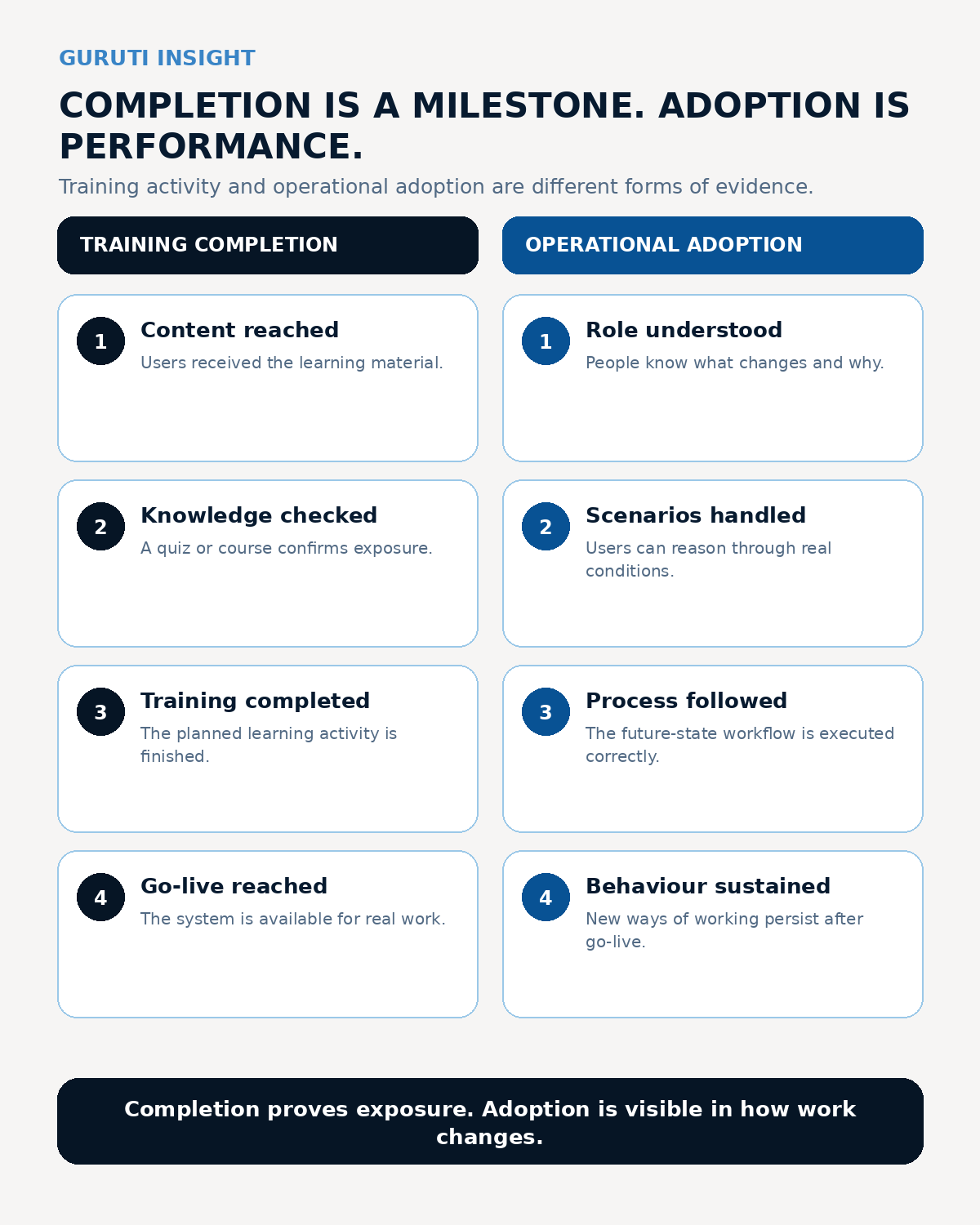
The wrong question: “Have users been trained?”
A more useful question is:
Are people able to operate the future state with sufficient understanding, confidence and support?
Those are not the same question.
Traditional implementation training often follows a simple sequence:
System content → Training delivery → Completion → Go-live
A transition-centred model looks different:
Future-state change → Role understanding → Context → Process logic → Real scenarios → Practice → Hands-on application → Reinforcement → Adoption evidence
The first model measures exposure to information.
The second tries to build operational capability.
That is the shift organizations need to make.
Start with what people need to do differently
Learning architecture should begin with the future operating model, not with the software menu.
Before designing modules, videos or workshops, ask:
- Which roles are changing?
- Which decisions will be made differently?
- Which responsibilities move from one team to another?
- Which local workarounds should disappear?
- Which existing knowledge must be preserved?
- Which exceptions are operationally critical?
- Which new controls must become habitual?
- Which terminology needs a common definition?
- What should users be able to do without support by go-live?
- What can reasonably be learned only after users encounter real production situations?
This produces a very different curriculum from a feature-by-feature system demonstration.
The software still matters. People need to know how to use it.
But the sequence changes from “Here is the system” to “Here is how your work is changing, and here is how the system supports that change.”
That difference is often where adoption begins.
Learning should follow the transition, not the project calendar
Implementation programmes frequently compress training into the final weeks before go-live because the project plan treats learning as a deployment deliverable.
But people do not absorb every type of knowledge at the same moment.
Some learning belongs early, when teams need orientation and a reason to engage.
Some belongs during design, when key users and process owners need to understand future-state decisions.
Some belongs close to go-live, when users can connect training to the work they will soon perform.
Some only becomes meaningful after go-live, when the organization encounters real exceptions, customer situations, operational pressure and edge cases.
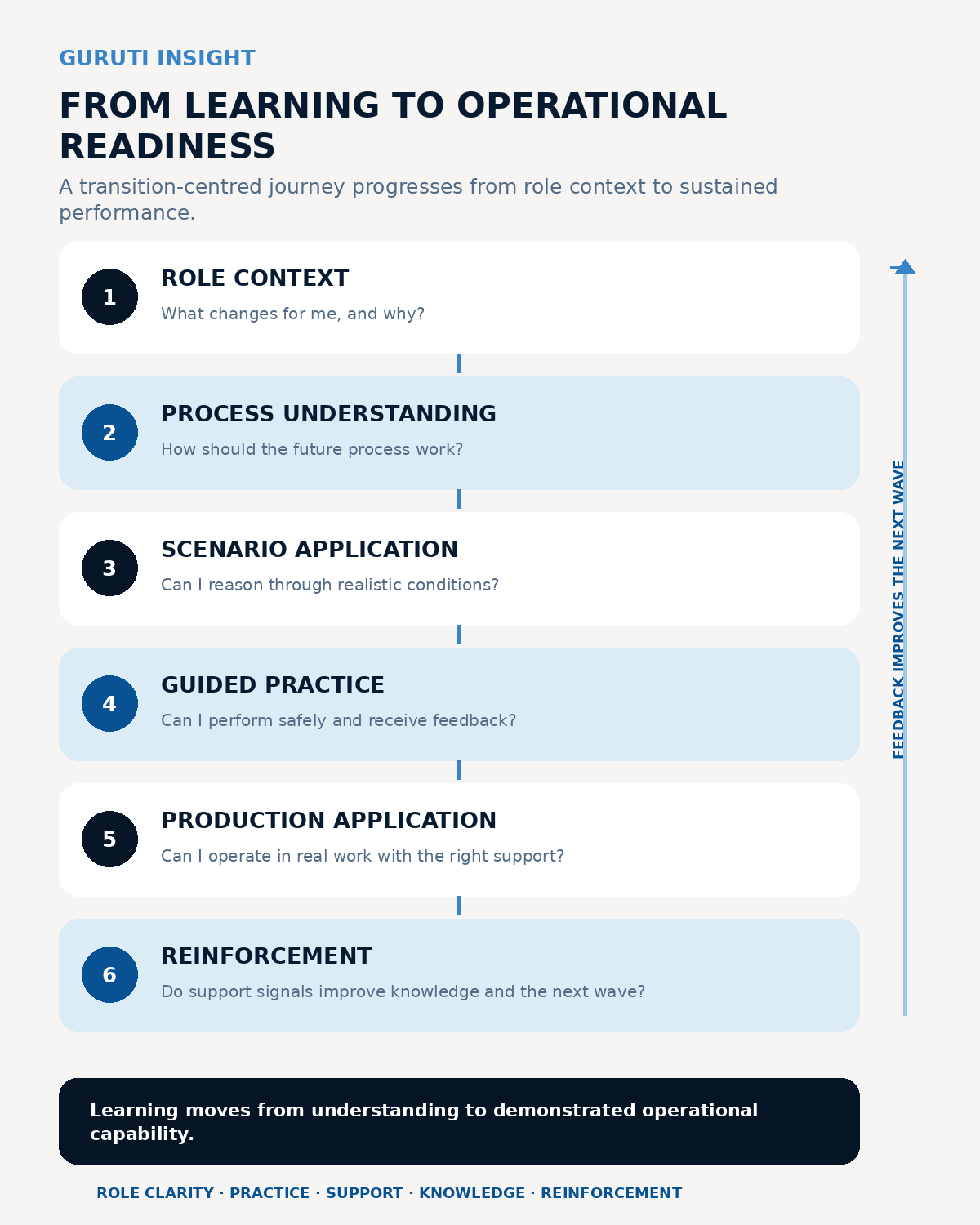
A more useful learning journey may therefore progress through:
1. Role context: understand the transition and what changes for me
Why are we changing? What business problem are we solving? What will be different? What remains stable? Different users need different depth: executives, managers, super-users, functional specialists, frontline users and support teams should understand the change through the context of their role.
2. Process understanding: understand the operating logic
Terminology, future-state process, responsibilities, controls, data principles, standards and decision rights should come before detailed navigation. People need to understand how the future process is intended to work and why.
3. Scenario application: connect understanding to reality
Use day-in-the-life scenarios, exceptions, handoffs, customer situations and cross-functional cases rather than only ideal demonstration flows. Scenarios help people reason through the future state before the pressure is real.
4. Guided practice: build confidence safely
Practice in a training environment, sandbox, simulation or guided exercise so users can apply the process, make decisions and receive feedback before production.
5. Production application: bridge learning and real work
Where appropriate, connect onboarding to supervised real-world use, hypercare, floor support, coaching or structured post-go-live tasks. Learning should move closer to the work as confidence grows.
6. Reinforcement: make the new model stick
Refreshers, knowledge updates, targeted microlearning, office hours, champions, manager reinforcement, support analysis and corrective learning should continue as the organization discovers where readiness is weaker than expected. Support signals should feed knowledge updates and improve the next wave.
Learning therefore becomes a transition architecture, not a one-time event.
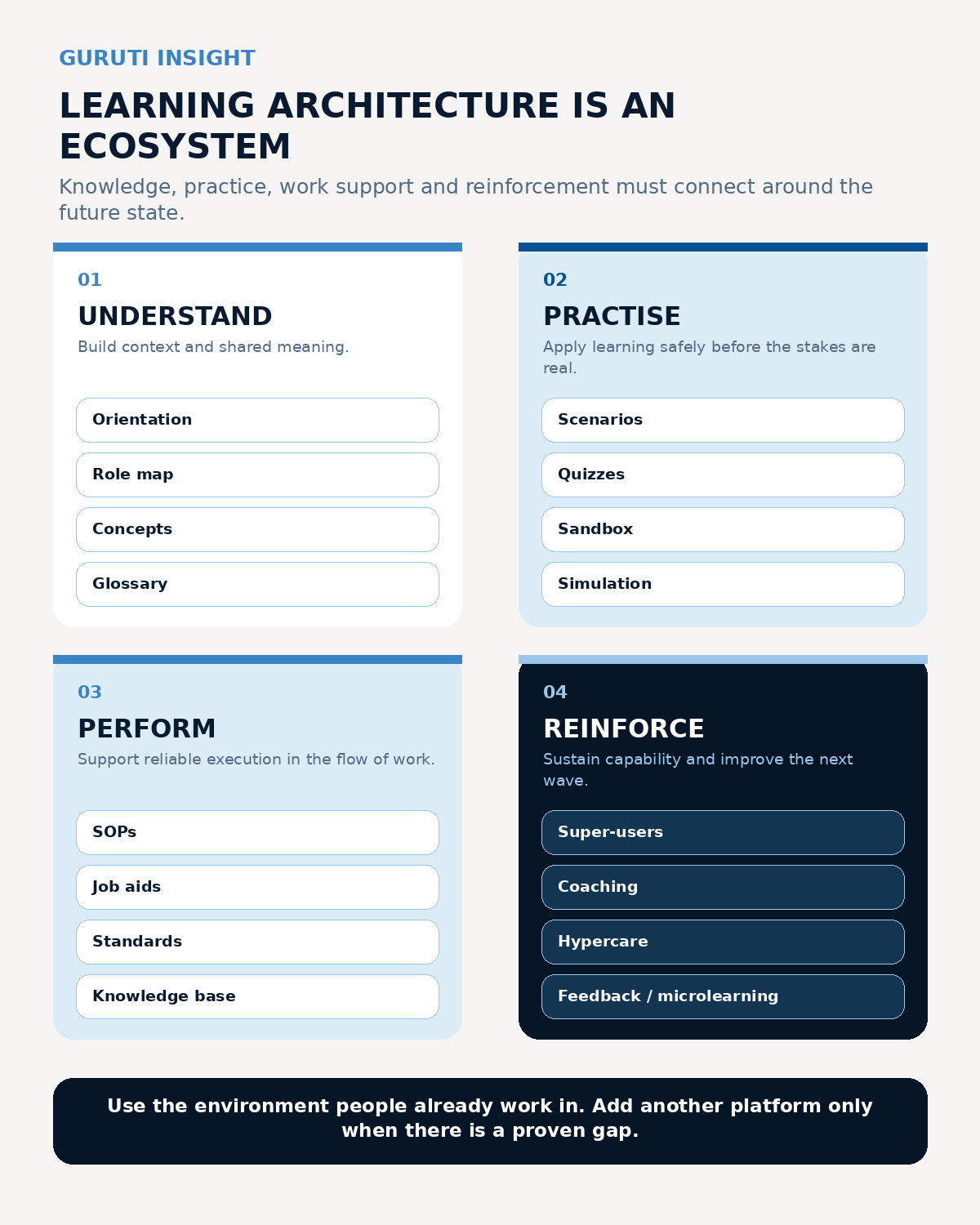
Build a learning ecosystem, not a pile of training files
The strongest implementation learning environments are rarely built around one format.
Different moments require different assets.
A learning ecosystem can combine:
- concise introduction lessons and executive orientation;
- role-based learning paths;
- visual process maps and operating journeys;
- short explainer videos;
- interactive walkthroughs or lightweight learning apps;
- scenario-based exercises;
- quizzes and knowledge checks;
- sandbox exercises and guided practice;
- key-takeaway repositories;
- searchable glossaries and terminology libraries;
- SOPs and operating guidelines;
- standards and specification notes;
- process and decision guides;
- checklists and job aids;
- troubleshooting guides;
- frequently asked questions;
- knowledge bases and wikis;
- reusable playbooks;
- super-user and train-the-trainer materials;
- post-go-live reinforcement content;
- links to the current source of truth rather than duplicate documents that quickly become obsolete.
The delivery layer should fit the client environment.
For some organizations, a SharePoint Communication Site can become the transformation hub: one place for announcements, navigation, role guidance, learning assets, key decisions and current documentation.
For Microsoft 365 environments, learning may also be surfaced through Teams or Viva Learning so people can discover content closer to their daily work.
For Odoo environments, native eLearning, quizzes, certifications, additional resources and Knowledge can support structured learning and reusable documentation.
Other organizations may already have an LMS, employee portal, knowledge platform or service-management knowledge base that should be reused rather than replaced.
The principle is vendor-neutral:
Use the environment people already work in whenever it can support the learning need. Add another platform only when there is a proven gap.
Make learning easier to consume, without making it shallow
Training becomes more accessible when people can get the right level of information at the moment they need it.
That can mean replacing one three-hour generic session with a combination of:
- a ten-minute orientation;
- a visual role map;
- a short process lesson;
- a realistic scenario;
- a practice task;
- a searchable glossary;
- a one-page job aid;
- a quiz or knowledge check;
- an SOP for the formal standard;
- and a post-go-live knowledge article for exceptions.
The objective is not to make learning entertaining for its own sake.
Creativity matters when it improves comprehension, memory, confidence or access.
Interactive assets, visual stories, branching scenarios, quizzes, microlearning, simulations and well-designed digital hubs can make learning more engaging. But the real design question remains:
Does this help the person perform the future-state work correctly?
That keeps innovation connected to operational value.
The human component is more than skill
A user may know how to complete a transaction and still resist the future process.
A manager may understand the workflow but continue reinforcing the old behaviour.
A functional expert may be capable of using the new system but distrust a control that removes local discretion.
A team may understand the technology but remain uncertain about who owns exceptions.
These are not always training gaps.
They may be questions of mindset, trust, incentives, ownership, confidence, identity, operating logic or accumulated experience.
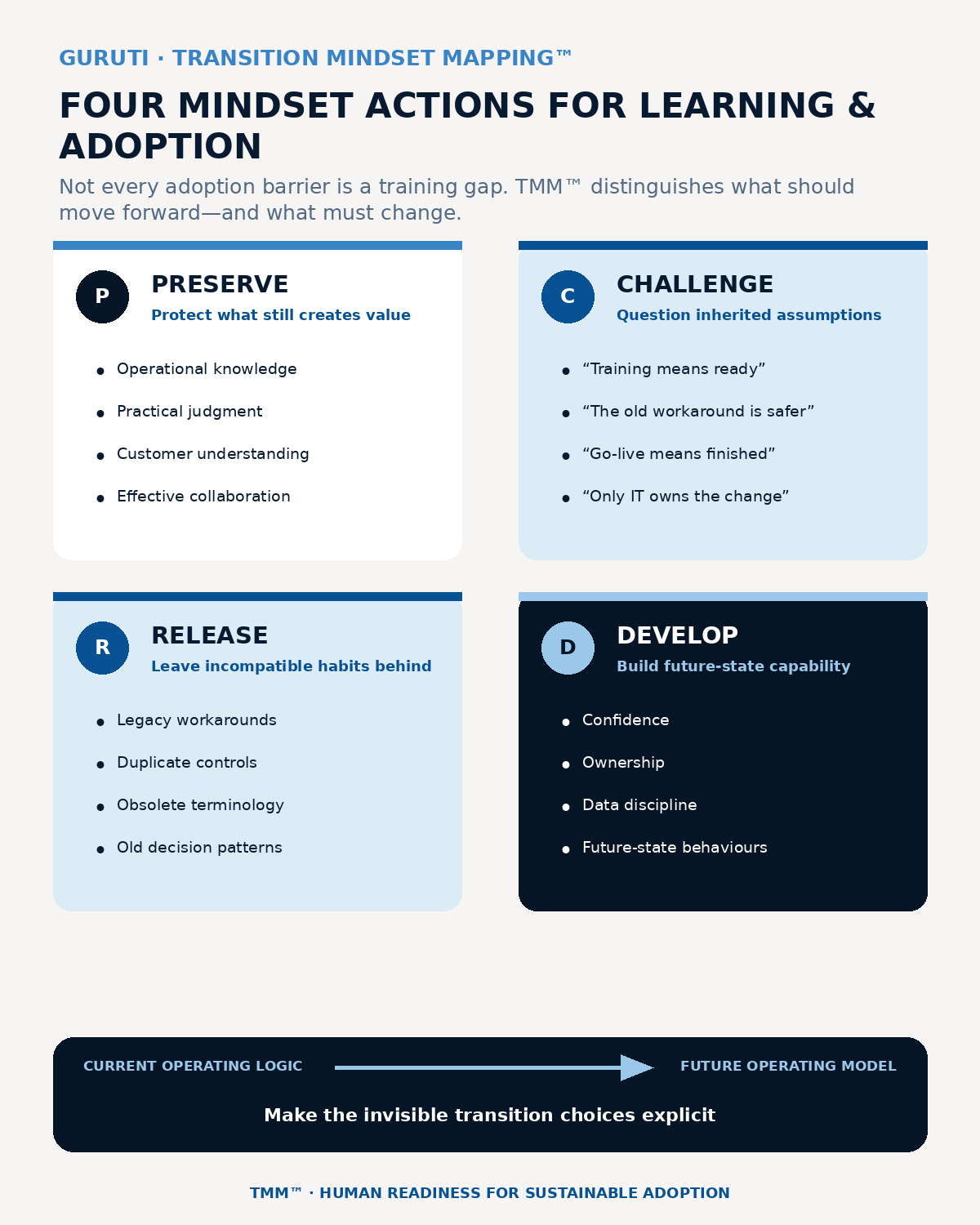
This is where Transition Mindset Mapping™ adds a different lens.
TMM™ looks at what people and stakeholder groups need to preserve, challenge, release and develop as they move from the current state toward the future state.
Applied to learning architecture, that can help distinguish four very different needs:
Preserve
Protect operational knowledge, customer understanding, practical judgment and local expertise that still creates value in the future state.
Challenge
Question assumptions such as “we have always done it this way”, “the spreadsheet is safer”, “only my team can own this step” or “the new system should reproduce every legacy workaround”.
Release
Move beyond behaviours, duplicated controls, terminology, manual files or decision patterns that the future operating model is designed to replace.
Develop
Build the skills, confidence, ownership, data discipline, judgment and operating habits required to sustain the new model.
This prevents learning from becoming a blanket intervention.
Sometimes people need more training.
Sometimes they need clearer process ownership.
Sometimes they need practice.
Sometimes they need better support.
Sometimes the process itself needs redesign.
And sometimes rational resistance is exposing a real operating risk that the project should listen to.
Human readiness begins by diagnosing the difference.
From theory to practice to production
The most useful learning programmes create a progression from understanding to independent performance.
A simple model is:
Understand → Apply → Practice → Perform → Reinforce
For a software deployment, that could mean:
Introduction lesson
Understand the transformation, terminology and role impact.
Theory / process module
Understand how the future process should work and why.
Scenario workshop
Apply the process to realistic situations.
Sandbox or guided practice
Perform transactions and decisions in a safe environment.
Production onboarding
Use the process in real work with appropriate supervision, support or hypercare.
Knowledge and reinforcement
Use SOPs, job aids, knowledge articles, FAQs, coaching and feedback to improve after go-live.
This sequence is applicable well beyond one platform.
It can support an Odoo implementation, an OPERA or other PMS migration, a CRS transition, CRM redesign, POS deployment, finance-system integration, service-management implementation, AI onboarding or a broader operating-model change.
The technology changes.
The transition challenge is remarkably consistent:
people need to understand the future state, practise it, operate it and sustain it.
Measure adoption beyond attendance and completion
Completion data is useful. It can tell you whether people reached the learning material.
It should not be confused with operational adoption.
A stronger evidence chain is:
Exposure → Understanding → Practice → Behaviour → Process Adoption → Operational Outcome
Depending on the transformation, useful signals can include:
- confidence or readiness feedback;
- scenario or quiz performance;
- completion of role-critical practice;
- use of knowledge assets;
- support-ticket themes;
- repeat errors and exception patterns;
- process adherence;
- data-quality indicators;
- transaction or workflow completion;
- use of old workarounds;
- manager or super-user observations;
- time-to-confidence after go-live;
- adoption and system-usage data;
- operational KPIs connected to the changed process.
No single metric proves adoption.
The point is to connect learning evidence with how the organization actually starts operating.
What Guruti can contribute
Guruti's role is not to force organizations into a standard training catalogue or a specific learning platform.
The opportunity is to design the learning and knowledge architecture around the transformation itself.
Depending on scope, Guruti can support:
- learning-needs and audience analysis;
- role and capability mapping;
- future-state learning architecture;
- redesign of existing implementation training;
- creation and adaptation of bilingual or multilingual learning content;
- onboarding journeys for SaaS, ERP, PMS, CRS and other enterprise platforms;
- executive, manager, key-user and frontline learning paths;
- theory-to-practice curriculum design;
- scenario and simulation design;
- quizzes, knowledge checks and practice exercises;
- SOPs, guidelines, standards notes and job aids;
- glossaries, key-takeaway repositories and searchable knowledge bases;
- SharePoint Communication Sites or equivalent transformation-learning hubs;
- interactive learning experiences and lightweight digital tools where they materially improve adoption;
- Odoo eLearning / Knowledge structures where native capabilities fit the requirement;
- train-the-trainer and super-user enablement;
- post-go-live reinforcement and knowledge-transfer plans;
- adoption evidence and feedback loops connected to the wider transformation governance.
This work sits between Human Readiness, Change & Adoption and Executive Education & Capability Building.
Human Readiness asks whether people are prepared to operate a specific future state.
Capability Building asks whether the organization can retain and reuse the knowledge and judgment required to continue operating and improving after the transformation team steps back.
A strong learning architecture supports both.
The objective is not to teach the system
There will always be a place for system training.
People need to know how to navigate the technology and complete the tasks their role requires.
But that is not the final objective.
The objective of implementation learning is to prepare people to operate the future state.
That means helping them understand:
- what is changing;
- why it is changing;
- what their role becomes;
- how the new process works;
- how the system supports it;
- what standards and controls matter;
- how to respond to real scenarios;
- where to find reliable guidance;
- how to ask for help;
- and how their organization will reinforce the change after go-live.
When learning is designed this way, training stops being a checkbox at the end of implementation.
It becomes part of the transformation architecture.
Strategy → Systems → Execution → Human Readiness → Sustainable Adoption
Selected sources
- Microsoft Dynamics 365 Implementation Guide: go-live readiness, change management, user support and post-go-live adoption monitoring.
- Microsoft Dynamics 365: measuring and adapting the user training experience through feedback loops.
- Microsoft Dynamics 365: realistic scenarios, competency and iterative improvement of training.
- Microsoft Viva Learning: learning integrated into Microsoft Teams and organizational content sources.
- SAP-sponsored IDC Spotlight, June 2026: digital adoption, in-flow guidance and learning closer to work.
- Odoo 19 eLearning documentation: courses, quizzes, additional resources and content tags.
These sources support specific implementation-learning and adoption principles. The framework and interpretation above remain independent GURUTI editorial analysis.
Is your implementation training people to use the system, or preparing them to operate the future state?
Guruti Solutions helps organizations connect transformation design, enterprise systems, human readiness and capability building. We can help assess the learning and adoption requirements around an ERP, PMS, CRM, AI, SaaS, integration or migration programme and design a proportionate enablement architecture around the operating reality.